Team Asprey

Neuroscientists Discover “Anxiety Brain Cells” That Can Be Turned On and Off

Neuroscientists at the University of California, San Francisco and Columbia University’s Irving Medical Center have discovered anxiety brain cells in mice that can be turned on or off. This could lead to new avenues for treating anxiety disorders in people. The findings are published in the latest issue of the journal Neuron.[ref url=”http://www.cell.com/neuron/fulltext/S0896-6273(18)30019-9″]

“Anxiety cells” in mice are triggered by stressful and frightening situations

The researchers inserted miniature microscopes into the brains of lab mice to record cell activity in the hippocampus – an area of the brain that regulates learning, memories, and emotions. They then placed the mice in stressful and frightening situations – open areas where they’d typically be exposed to predators as well as elevated platforms – to observe which cells fired.

Next, the researchers used a technique called optogenetics (beams of light used to control neuron activity) to regulate those cells by turning them up and down. When the researchers turned down the cells, the mice spent more time on the elevated platforms and away from protective walls, demonstrating less anxious behavior. But when they stimulated the cells, the mice exhibited more anxiety-ridden behaviors, even when in a safe space. There is still much to do to before using the same techniques to combat anxiety in humans, however, it does point to possible treatments down the road. “If we can learn enough, we can develop the tools to turn on and off the key players that regulate anxiety in people,” said Joshua Gordon, director of the NIMH, which helped fund this study.

Anxiety disorders are hardware problems in the human brain

It’s important to point out that anxiety disorders are often misclassified as personal shortcomings, when they are actually hardware problems in the brain. This mouse study demonstrates that overactive brain cells lead to anxiety. Your anxious behavior, in other words, is not a sign that you’re not strong, resilient, or smart enough to beat it.

Ease your anxiety by reprogramming your brain

There are steps you can take right now to ease your anxiety, specifically by working to reprogram your brain.

  •    Get a handle on your heart rate variability in two straightforward steps. Step one – recognize your bodily sensations when your flight-or-fight response is triggered. Step two – learn how to control your flight-or-fight response, so you can consciously curb it and remain calm.  HeartMath is an exceptional HRV unit. Learn more about HRV training here.
  •    Seek out a cognitive behavioral therapist to help you reframe your thoughts and, by extension, your actions. Or find a therapist who specializes in EMDR (eye movement desensitization and reprocessing), which can be an effective way to retrain your nervous system responses.
  •    You can also try neurofeedback with a skilled professional, which allows you to work with your nervous system responses through your own brainwaves.
  •    For more in-depth information on how to restore your brain’s hardware and combat anxiety, check out Dave’s newest book, Head Strong.
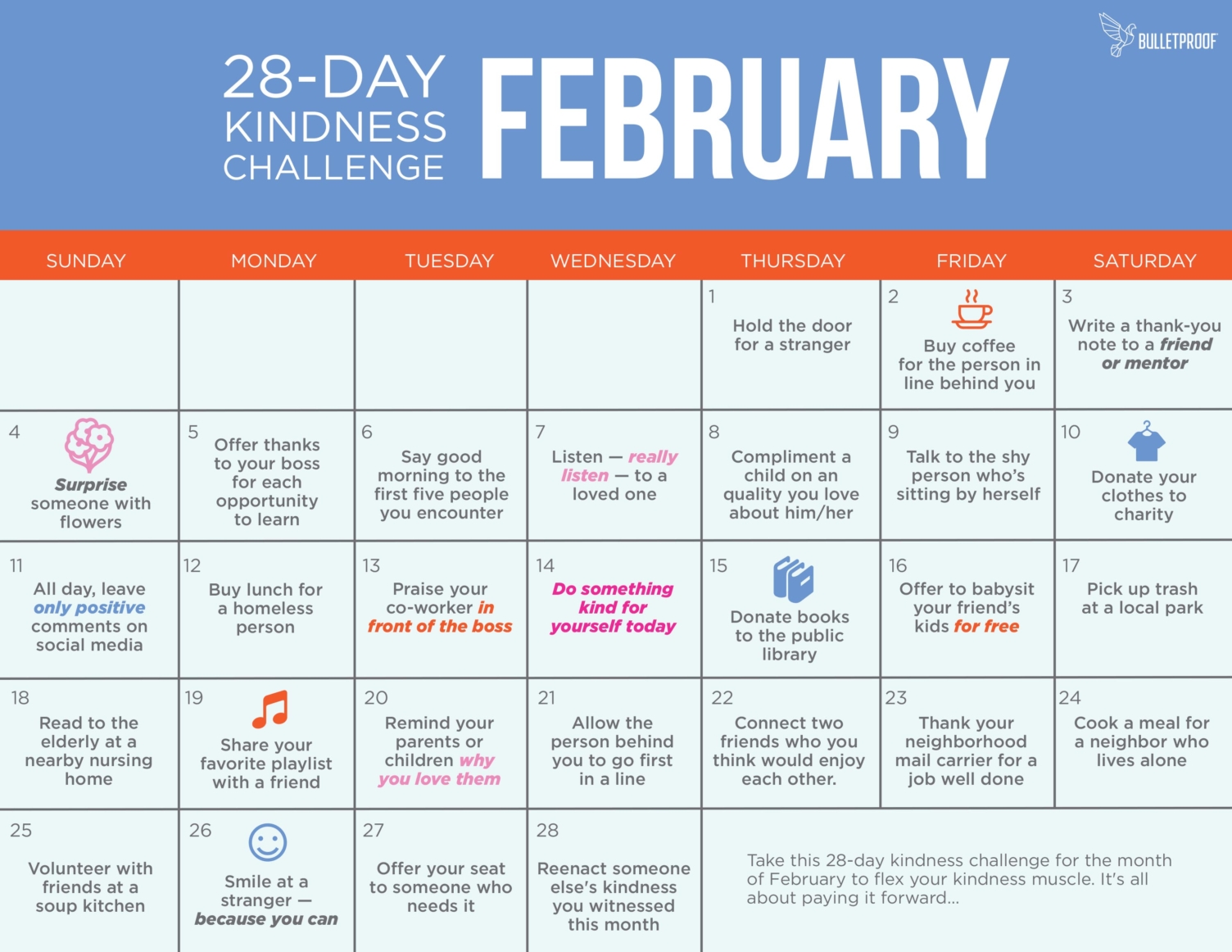

 

Take the 28-Day Kindness Challenge and Restore Your Faith in Humans

Make February your month to flex your kindness muscle. Studies show that just one random act of kindness a day reduces stress, anxiety, and depression[ref url=”http://care.diabetesjournals.org/content/39/11/1963″]. According to David R. Hamilton, Ph.D., one small act of compassion invigorates your body with feel-good hormones like serotonin — making you calmer, healthier, and happier. Kindness accompanied by emotional connection also releases oxytocin, which in turn is cardioprotective as it lowers blood pressure. Kindness makes others feel good, too. Ready to feel more energized, confident, and even perhaps live longer? Pay it forward each day this month with these simple acts of kindness. Go for it — start small and maybe, just maybe, you’ll spark a chain-reaction through your community. After all, kindness is contagious.

Get a printable version of the Kindness Calendar


Walking 10,000 Steps a Day Is Bad Advice, Finds New Report

Been feeling bad about not hitting those 10,000 steps a day? A new BBC experiment suggests that this fitness goal isn’t all it’s cracked up to be. In fact, a news report reveals that the health advice to walk 10,000 steps a day has zero science behind it, and was instead a part of a marketing campaign to get people excited about the Olympics.

“10,000 steps” is part of an outdated marketing campaign – not a useful fitness strategy

The origin of the 10,000 steps regimen is actually tied to a 1960s marketing campaign in Japan leading up to the 1964 Tokyo Olympics. Concerned that Japanese people would fall victim to a Westernized lifestyle, Dr. Yoshio Hatano, an academic at Kyushu University of Health and Welfare wanted to get people more active. He believed that if he could increase their daily steps from 4,000 to 10,000, then they would burn approximately 500 extra calories a day and remain slim.

Shorter durations of brisk walking beat out 10,000 steps

Recently, British journalist and author Michael Mosley and Professor of Physical Activity and Health at The Centre for Sport & Exercise Science, Sheffield Hallam University visited a factory in Sheffield with a goal to compare the benefits of 10,000 steps to “Active 10” – a program aimed at approximately three sessions of 10 minutes of brisk walking each day. Their small group of volunteers wore activity monitors to measure what exercise they did, as well as how vigorously they did it. A normal day’s activity constituted a control. Copeland divided the group into two – group one walked 10,000 steps (about 5 miles) each day, while group two completed three sessions of Active 10, which equates to about 3,000 steps or 1.5 miles.

The results revealed that the Active 10 group actually completed 30% more ‘moderate to vigorous physical activity’ than the 10,000 steps group, though they exercised for a shorter duration.”It’s when you are doing moderate-intensity activity that you are starting to get the greatest health benefits. There’s lots of evidence to suggest that by [getting your heart beating faster] you can lower your risk of diabetes, cardiovascular disease, and some cancers,” explains Copeland.

Bulletproof your exercise routine with these key ingredients

The goal of exercise is to utilize the most efficient techniques that get the job done in the smallest amount of time and effort. Like doctor, weightlifter, and author Doug McGuff states in Body by Science: Exercise should be brief, intense, infrequent, safe, and purposeful. It’s no surprise that 10,000 steps is not winning at this point.

So what is the best kind of exercise to do? A combination of resistance and aerobic training – like HIIT (high-intensity interval training) – is an excellent choice. It alternates between brief, strenuous exercise and active rest. You might sprint for 60 seconds, walk for 30, do push-ups for 60, walk for 30, and so on. Learn more about HIIT’s benefits and how to do it here. Bonus:  HIIT is key for keeping weight off too.

Related: Bulletproof Diet: How To Get A Bulletproof Body


Can’t Resist Cravings? Meditation Can Help

Looking for a way to keep cravings in check? You might want to give breathing exercises a try. A new review from City, University of London reports that mindfulness strategies, such as meditation, interrupt food and drug cravings. Specifically, mindfulness techniques engage the portion of the mind that controls short-term memory, which diffuses cravings in the moment.

Try These Deep Breathing Exercises Now

A 30-study review reveals mindfulness meditation reduces cravings

The review of 30 studies confirms what ancient Buddhist texts articulated all along – cravings (which lead to suffering, say Buddhists) are avoidable through mindfulness meditation practice. The compilation of studies reveals that mindfulness strategies are effective because they interrupt cravings by loading “working memory” – a part of short-term memory associated with perception and language skills. Additionally, the review asserts that mindfulness reduces cravings over the medium-term, due to the “extinction process.” This means by meditating, you block cravings and related behaviors at the onset, which translates to reduced cravings overall.

“The research suggests that certain mindfulness-based strategies may help prevent or interrupt cravings by occupying a part of our mind that contributes to the development of cravings. Whether mindfulness strategies are more effective than alternative strategies, such as engaging in visual imagery, has yet to be established. However, there is also some evidence to suggest that engaging in regular mindfulness practice may reduce the extent to which people feel the need to react to their cravings, though further research is needed to confirm such an effect,” says Dr. Katy Tapper, author of the review and a Senior Lecturer in the Department of Psychology at City, University of London.

Practice mindfulness to strengthen your willpower and avoid cravings

Mindfulness interventions like meditation encompass a variety of goals including cultivating greater awareness of bodily sensations, creating an attitude of acceptance towards discomfort, and even helping you to perceive yourself as distinct from your thoughts and emotions. In other words – you don’t have to act on every urge or impulse. Mindfulness teaches you to observe and accept the present moment – without judgment. This trains your brain to build resilience against discomfort and distractions, like pain or cravings.

Related: The Benefits of Meditation

In Bulletproof speak, reacting mindlessly to external stimuli is letting your  “Labrador brain” get the best of you. Your Labrador brain is the area that controls your survival instincts and urges you to pursue food and sex impulses indiscriminately. This can make you want to devour everything in the fridge. However, there are ways to tame (and train) your Labrador – through willpower, which, just like any other muscle in your body, can get stronger and more resilient with practice. Meditation helps flex your willpower muscles by adding a moderating step between impulse and action, so you don’t act on your impulses as readily. Get specific tips on how to strengthen your willpower muscle here to get a handle on those cravings once and for all.

Read Next: How to Meditate More Effectively


How a Positive Attitude Leads to Better Performance

IQ isn’t everything. If you’re looking to build skills and boost your performance at work, positive attitude goes a long way.


A new Stanford study confirms that success lies in the power of positive thinking[ref url=”http://med.stanford.edu/news/all-news/2018/01/positive-attitude-toward-math-predicts-math-achievement-in-kids.html”]. The study found that a child’s positive attitude is just as relevant as his or her IQ in predicting performance. When elementary school students completed arithmetic problems, a positive attitude towards math was connected to better function of their hippocampus, a vital memory center in the brain.

A positive attitude leads to success in math

The study included 240 children ages 7-10, who performed arithmetic problems testing their knowledge of math facts and math word problems. Researchers assessed the children’s demographics, IQ, reading ability, and working-memory capacity. The children’s guardians answered surveys about the children’s behavioral and emotional characteristics – including their anxiety about math and in general. The children then answered a survey addressing their “math attitude” – their interest in math and self-perceived abilities in the subject. 47 children also took MRI brain scans while performing the tests.

By analyzing the brain-imaging results, researchers found that a child’s positive-attitude scores directly correlated with activation of their hippocampus, the memory and learning center of the brain. These results suggest that the hippocampus is the connection between a can-do attitude and nimble fact-retrieval from memory, which is associated with problem-solving abilities.

Lang Chen, PhD, the study’s lead author and a postdoctoral scholar in psychiatry and behavioral sciences, summed up the findings: “Attitude is really important. Based on our data, the unique contribution of positive attitude to math achievement is as large as the contribution from IQ.” In other words, beliefs about a particular subject, as well as self-perceived abilities, bare weight on the success of an outcome.

How to gain more happiness and success

While this study focused specifically on children and math, past research has shown that visualizing success helps you achieve your goals. With that in mind, it’s never too late in life to set yourself up for success by giving your attitude an overhaul. Here’s how:

Visualization: The act of thinking about a goal and seeing yourself achieving it can work wonders. Set aside some time each morning to envision yourself succeeding at something you’ve dreamed of. Be as specific as possible in your visualization. What is important is to tap into the emotions of happiness and joy you experience upon reaching that goal. You want to recreate that – in real time, in real life. Read here for more ways to open up the performance-enhancing intuitive side of your brain.

Cognitive Behavioral Therapy (CBD) is also an effective tool to help you change how you think about certain things, so you approach them differently. Negative thinking, for example, keeps people in a depressed state of mind. Learning to undo that thought pattern to allow the positive thoughts to bubble through can help depressed people feel better. In that way, even a daily gratitude practice can help. Self-efficacy – your belief in your ability to succeed – plays a major role in how you think, feel, and behave. Seek out a qualified CBD therapist or practitioner to help you learn the ropes.


Here’s Why You Should Consider a Dry February

  • Among the reasons to abstain from alcohol for one month, you will have the opportunity to take stock of your drinking habits and understand your relationship with alcohol. You’ll also likely save money, and experience noteworthy health benefits.
  • Health benefits may include: increased energy, greater productivity, regular digestion, better sleep, clearer skin, weight loss, stronger immune system, and improved mood.
  • Make your month of abstinence as easy (and temptation-free) as possible — clear your calendar, clean out the fridge, and pre-plan your meals in advance.
  • Follow these tips to make it through the month: download an app to stay on track, venture out of the house to try something new, and remember why you started…

So you missed your chance to do a dry January. No worries. You can challenge yourself to go alcohol-free any month of the year, and bonus: February, being the shortest month, is one of the easiest ones to tackle. Dry February gives you a chance to observe your drinking habits and welcome greater health and balance into your life. Whether you intentionally missed the boat with #DryJanuary or are just warming up to the notion of a month of abstinence, it’s never too late to embark upon a health challenge. Still need some convincing that a month without wine is actually a good thing? Read on to learn the surprising health benefits of giving up alcohol. Plus, get some pre-planning tips and tricks to help you get through the month without falling off the wagon.

Here’s why you should go dry in February

Undeniably, your reasons to abstain from alcohol for a month are personal. However, you if you are still on the fence, consider these perks:

  •    It’s an opportunity to take stock of your drinking habits and better understand your relationship with alcohol – how much you drink and why. Ask yourself what you want your drinking habits to look like long-term, and keep the big picture in mind so you don’t go hog wild come March 1.
  •    It’s a chance to hit the reset button. If you drink more than you probably should (or even if you don’t), a dry February lets you see how your body responds to less alcohol. Chances are, you’ll feel better, sleep better, have better focus, and maybe even lose weight.  
  •    You’ll see more of life and what it has to offer. When you can’t reach for a cocktail at the end of a long week, what other outlets will you discover?
  •    You’re bound to experience more meaningful connections with others when the booze is out of the equation.
  •    You’ll likely save money. Enough said.

Dry February Health Benefits Clear Skin

Health benefits of a dry February

No matter how much you want it to be, alcohol is not good for humans, especially in large quantities. (No judgment; it makes us sad, too.) Research shows that drinking alcohol produces a harmful chemical in the body that leads to permanent genetic damage and increases the risk of cancer.

While the end results of your dry February depend somewhat upon previous drinking behavior (you’ll notice the most profound changes the more you were drinking before), here are some of the health benefits of giving up alcohol, even temporarily:  

  •    Clearer thinking
  •    Increased energy
  •    Greater productivity
  •    Regular digestion (too much alcohol messes with your gut’s microbiome)
  •    Improved motivation to stick to good habits
  •    Better sleep
  •    Clearer skin
  •    Weight loss
  •    Greater sense of achievement
  •    Stronger immune system
  •    Less stress on the liver
  •    Improved mood
  •    More money in the piggy bank

Related: Alcohol Addiction: How to Quit Drinking for Good

How to ease your way into dry February

The month before going booze-free, start cutting back on alcohol to make the transition easier. Aim to cut your alcohol intake to half of your normal consumption. This will help shift your mindset and bodily response to alcohol before you go full-throttle in February.

If alcohol is your salve for a rough day, find healthier ways to cope with stress before February hits, so you don’t have to white-knuckle it. Visit yoga studios, download meditation apps, try an endorphin-boosting workout or soak in a bubble bath. See what works for you and what doesn’t.

  •       Mix up your alcohol outings with dancing, games, or conversation. Did someone say pool or darts?
  •       Slow down – give yourself an hour between drinks and switch between alcohol and water.

How to head off temptation ahead of time

A little planning can go a long way toward your success for the month. Keep these tricks of the trade in mind for February:

  •       Get a handle on your calendar. Ensure that you aren’t battling too much stress in February and do whatever you can to minimize excess engagements now.
  •       If you have plans that might lure you from your goals – rein in a sidekick who will help you stay on course through the month.
  •       Come up with crafty drink substitutions – mocktails, ginger beer, non-alcoholic beers, wines, herbal tea, and coffee. Did you read that last one? Coffee!
  •       Pre-plan your meals with thorough shopping lists for the month.
  •       Clean out the fridge, freezer, and cabinets of all tempting substances.
  •       Mentally prepare – snatch up a quote book for on-the-go inspiration. If you are the writing type, get your hands on a journal too, so that you can process the month one day at a time.

Dry February Popcorn Movies Relax

How to make it through the month – and enjoy it

Though you might be overwhelmed – even a little panicked – come February 1, you can make it through the entire month without alcohol. Here are some fresh tips to shift the pendulum toward success:

  •       Educate yourself further about the benefits of abstinence. It’ll go a long way to keep you motivated.
  •       Download an app like Sobriety Counter or Sober Grid to help you stay on track and mark your progress.
  •       Go for the double whammy – pair your alcohol-free month with another health goal like exercise. Every time you desire to drink, focus on your other goal as a positive distraction. Want a drink? Go for a walk. Friends doing brunch? Hit Soulcycle instead.
  •       Hang out with people who don’t drink or are doing a dry month as well. This is a great month to widen your social circle.
  •       Venture out of the house with all that new energy you have to try something new – something noteworthy you’ve always wished to try before.
  •       Get cultured. Ditch the bars for a sporting event, peaceful evening at home, or trip to the cinema.
  •       Worried about questions from onlookers? Go for soda water with lime or lemon when you’re out – it looks just like a gin and tonic.
  •       Remember why you started. Whatever your motivation for embarking on a dry month, remind yourself of this intention throughout the 30 (ok, 28) days to help you keep on keeping on.

Before you know it, you’ll be ringing in March 1 with a glass of champagne – or maybe a cup of relaxing kava tea. Either way, you’ll have learned something meaningful about the experience and given your body a well-deserved break from alcohol.

Related: What to Drink: Bulletproof Alcohol Infographic and Hangover Cures

Eager for more inspiration? Here’s how one woman tackled 30 days of no drinking:


Start hacking your way to better than standard performance and results.

Receive weekly biohacking tips and tech by becoming a Dave Asprey insider.

By sharing your email, you agree to our Terms of Service and Privacy Policy