The Key To Staying Active In The Winter 

The Key To Staying Active In The Winter 

It’s getting colder outside, which means that for many of us, our fitness routines are starting to look a little different. I’ll just come out and say it: it’s hard to stay in shape when it’s dark at 4:30 pm and freezing cold outside. 

Unsurprisingly, studies show that most people are less active during the colder months. I guess we humans just like to hibernate in the winter[1][2].  

But the problem is… we’re not bears. 

As humans, we need to move, and we need to keep moving each and every season. When we don’t, we start to gain weight, our respiratory endurance takes a hit, and we lose strength and flexibility. And perhaps worst of all, we get depressed. That winter slump isn’t only due to the lack of daylight; your body likes to move so it can produce endorphins[3]. 

On the other hand, when we keep moving all year, we’re much more likely to stay physically fit, and studies support physical activity for warding off the doom and gloom of seasonal affective disorder (SAD)[4].

So, instead of giving in to the darkness this winter, let’s talk about some simple and effective ways to stay active, healthy, and, dare I say… happy this winter. 

How To Keep Moving This Winter

Woman doing an online workout

Online Workouts

Online exercise programs have been around for a while, but since the pandemic, you can find almost every type of workout available at your fingertips. Even those classes you thought would never go virtual have likely made their way into an online platform. 

While there’s something special about exercising with the community, online workouts are a great failsafe when the snow’s got you locked in or, frankly, when you just aren’t feeling the social vibes. I’d say if the clock hits five and you start feeling that siren song of the sofa, have one or two online workouts in your back pocket that you can bang out before calling it a day. 

Plan Ahead To Get Outside

Look, I know that some climates are truly foreboding in the winter, but if you plan ahead, you can still find some pockets of time for an outdoor adventure. During the week, you may not be able to sneak away for a couple of hours, but if you plan it just right, you may be able to make it out for a hike on a sunny winter day. 

Gearing up can also make weathering the cold a lot more enjoyable. Grab some boots, gloves, and a heavy coat if you know the winter chill is coming. You may be surprised how the cold becomes much more bearable when you’ve layered yourself up. 

And if you need a little motivation, studies show that outdoor activity during the colder months results in burning more energy (calories) than at other times of the year. Why? It takes additional energy to heat your body[5][3].

 Pro tip: make your outdoor adventure something special; a beautiful mountain hike or a walk by a serene lake will get your engines running a lot faster than a walk around the neighborhood. 

Winter hike in the mountains

Body Weight HIIT Workouts

We’ve all been there: snowed in with no way to get out, and you feel like you’re just about to crawl out of your skin. Your body is screaming, “Move me!” but your mind is saying, “Where?!”

Body weight HIIT workouts are the perfect option if you’re looking to expend a lot of energy in a short time with no equipment or outdoor access.

Studies show that HIIT workouts can increase aerobic endurance, maximal oxygen uptake, and anaerobic capacity more than traditional aerobic exercise[6]. Furthermore, HIIT workouts are known for their ability to help you shed excess weight – specifically that unwanted weight that can accumulate around the waist[7]. 

If you’re familiar with HIIT workouts, you may be able to improvise and create your own, but here’s a simple routine if you’re looking for inspiration: 

Time interval (40 seconds on, 20 seconds off), three sets each

Make sure to warm up before you get moving.

  • Jumping jax 
  • Squat jump
  • Burpees
  • Push-ups
  • High knees
  • Lateral jumps

This entire workout should take about 18 minutes, but you can shorten or extend it to your preference. 

Stationary Bikes
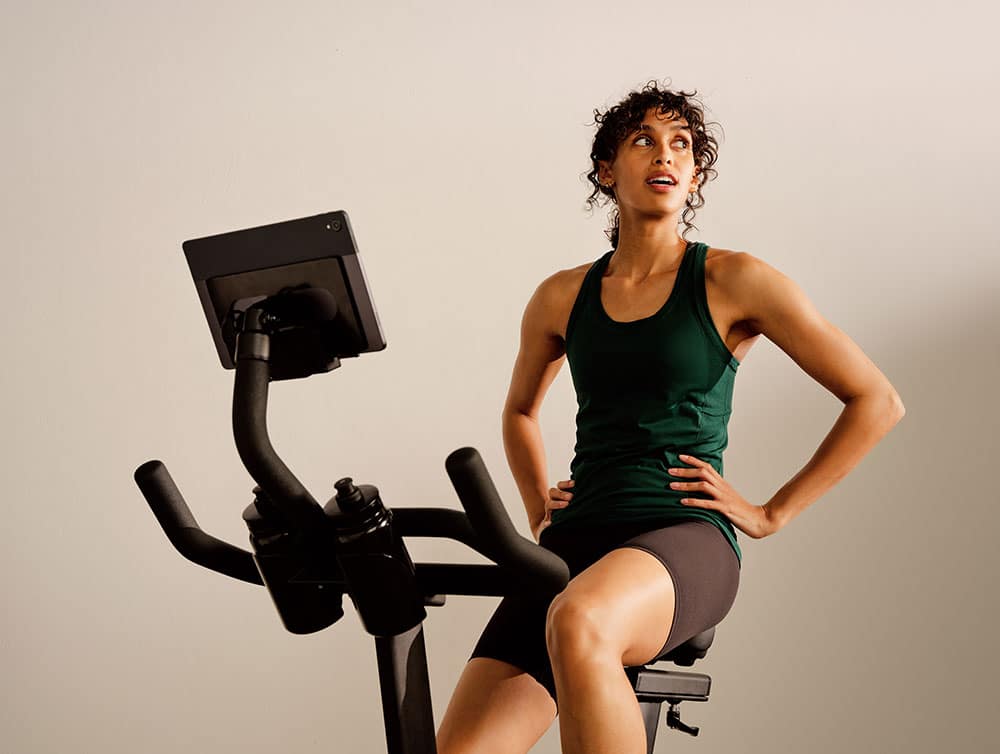
Woman resting after a CAROL Bike workout

Stationary bikes are an excellent option for anyone who wants to keep moving regardless of what’s happening outside. While training outdoors has its advantages, there are unique benefits that training on an indoor machine has to offer. Specifically, you can adjust the settings on indoor cardio equipment like bikes to rev up your workout and push yourself beyond what may be available outdoors. Many people even find they can exceed their previous cardio limits by training on equipment, making their outdoor workouts feel like a breeze.

One of my favorite cardio machines is the CAROL bike. There are a lot of stationary bikes out there these days, but this bike is tailor-designed and AI-enhanced to help you optimize your cardio workout in several ways. And the best part is that even if you’re really short on time, you can get a massive cardio workout on this bike in just a couple of minutes. And I’m not exaggerating – it just takes a couple of minutes.

And while I like to tinker around with different workouts now and then, it was the research that really sold me on the CAROL bike – no surprise there. 

In a study evaluating the effectiveness of reduced-exertion high-intensity interval training (REHIT) on cardiometabolic fitness, the CAROL bike crushed it. Participants using the CAROL bike for just eight weeks saw a 62% reduction in risk factors for metabolic syndrome, including reduced blood pressure, waist circumference, triglycerides, and increased HDL cholesterol (good cholesterol)[8]. 

And remember how I mentioned that HIIT workouts can enhance your maximum oxygen capacity? Well, the same study found that participants who engaged in CAROL Bike’s REHIT workouts three times per week experienced a 12.3% surge in their VO2 max. For comparison, a traditional 30-minute workout only increases VO2 max 6.9%, so with just 10% of the time investment, CAROL Bike can nearly double your oxygen capacity[8].
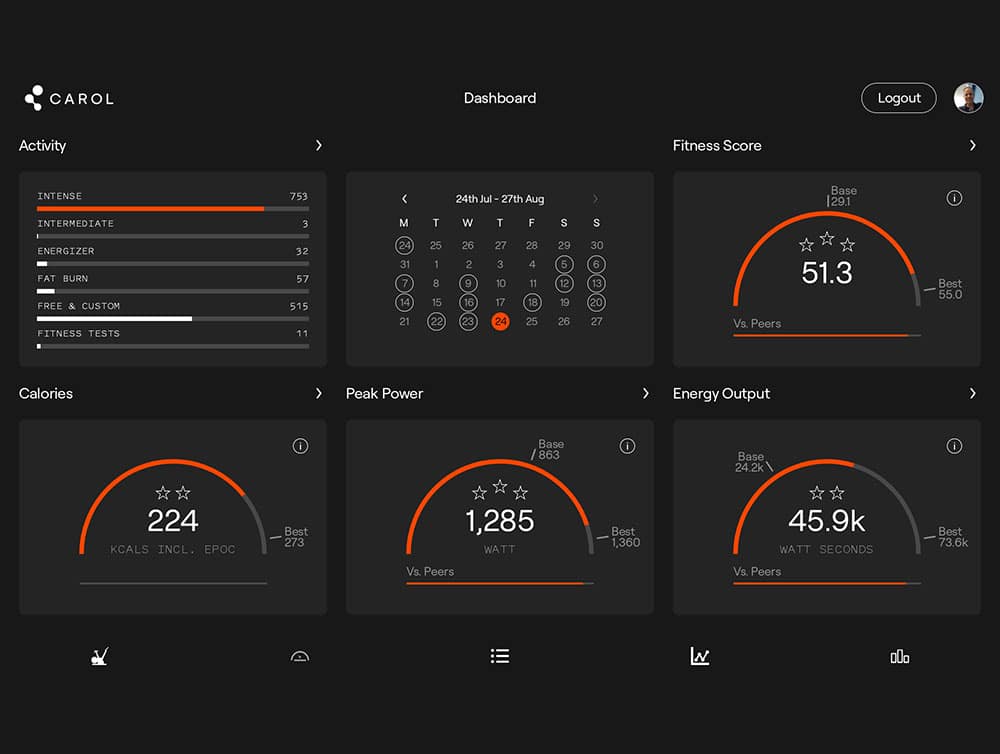
CAROL Bike dashboard

Takeaway 

Taking some downtime during the winter months isn’t bad, but we need to toe that delicate line between cutting back a bit and losing our healthy habits. My advice is to stay as active as possible while letting yourself enjoy a little bit of hibernation here and there. 

If you’re looking for ways to stay active during the winter, plenty of options exist. That said, one of the most effective I’ve found is using indoor equipment like the CAROL bike. It’s quick, fun, and highly effective at getting my heart rate up in a short amount of time. 

Enjoy these cooler months ahead, and remember that your cardio fitness won’t be patiently waiting for you in the spring; it needs some love all year round. 

References

  1. https://www.nrpa.org/about-national-recreation-and-park-association/press-room/new-survey-majority-of-u-s-adults-are-less-active-during-the-winter/
  2. Garriga, Antonio, et al. “Impact of seasonality on physical activity: A systematic review.” International journal of environmental research and public health 19.1 (2021): 2.
  3. Stanaszek, Monika, et al. “Effect of Winter Outdoor Physical Activity on Body Composition and Motor Performance of Polish Adult Men.” Healthcare. Vol. 11. No. 16. MDPI, 2023.
  4. Drew, Elaine M., Bridget L. Hanson, and Kevin Huo. “Seasonal affective disorder and engagement in physical activities among adults in Alaska.” International journal of circumpolar health 80.1 (2021): 1906058.
  5. Cepeda, Magda, et al. “Seasonality of physical activity, sedentary behavior, and sleep in a middle-aged and elderly population: the Rotterdam study.” Maturitas 110 (2018): 41-50.
  6. Atakan, Muhammed Mustafa, et al. “Evidence-based effects of high-intensity interval training on exercise capacity and health: A review with historical perspective.” International journal of environmental research and public health 18.13 (2021): 7201.
  7. Batacan, Romeo B., et al. “Effects of high-intensity interval training on cardiometabolic health: a systematic review and meta-analysis of intervention studies.” British journal of sports medicine 51.6 (2017): 494-503.
  8. Cuddy, Tom F., Joyce S. Ramos, and Lance C. Dalleck. “Reduced exertion high-intensity interval training is more effective at improving cardiorespiratory fitness and cardiometabolic health than traditional moderate-intensity continuous training.” International journal of environmental research and public health 16.3 (2019): 483. 

The Sleep Thermometer: How Temperature Impacts Your Sleep Quality

If you want to live a long and healthy life, getting quality sleep is vital. Sleep is essential for our overall well-being, and the quality of sleep we get can significantly impact our physical and mental health. 

Unfortunately, around 50 to 70 million people in the US have sleep issues – that’s an insane number, considering the US population is about 330 million[1].

So what’s the deal? Why are we all tossing and turning the night away?

While various factors contribute to a good night’s sleep (stress, caffeine intake, health issues, physical comfort), one often overlooked element is temperature. The temperature of both your body and your sleep environment plays a crucial role in achieving a restful night’s sleep.

In this article, we’ll dive into the details of exactly why the temperature in your sleeping environment matters and what you can do to optimize sleep temps so you can wake up ready to take on the day. 

Understanding the Sleep-Wake Cycle

Before diving into the impact of temperature on sleep, let’s talk about the basics of the sleep-wake cycle. Our body’s internal clock, known as the circadian rhythm, regulates our sleep patterns. It relies on various external cues to determine when it’s time to wake up and when it’s time to sleep. 

For instance, the sun’s position in the sky can either send a signal to wake up and get going or wind it down and get to bed. The same goes for meal timing. If you’ve just consumed a large meal, your body won’t be too keen on laying down for a night of rest. While most people know that when the sun goes down, their body will be more inclined to sleep and that eating a large meal before bed will likely cause some disturbance, sleep temperature is a detail that often slips through the cracks[2].

Your body’s core temperature naturally fluctuates over the course of a day. In the evening, your core body temperature begins to drop, signaling to your body that it’s time to prepare for sleep. Conversely, in the morning, your core body temperature rises, helping you wake up and feel alert. But if you sleep in a room that is too hot or too cold, it can mess with these natural fluctuations[3]. 

The Ideal Sleep Temperature

Maintaining a consistent, cooler room temperature, typically between 60°F (15°C) and 67°F (19°C), is ideal for optimizing sleep[4]. These cooler temperatures help your body regulate its core temperature, which aligns with the natural drop in core temperature needed for restful sleep. Furthermore, a cooler sleep environment can help improve your sleep, heart rate, and HRV[5].

The Impact of Temperature on Sleep Quality

Alright, now that you know the basics, how exactly does temperature impact sleep quality?  

  1. Falling Asleep Faster: A cooler sleep environment helps you fall asleep faster. When your room is too warm, your body has to work harder to cool down, delaying sleep onset. Cooler temperatures facilitate this process, making it easier to drift off into slumber.
  2. Deeper Sleep: A consistent room temperature supports deeper sleep. During the REM stage of the sleep cycle, your body loses some ability to regulate its temperature. A cooler environment helps mitigate temperature fluctuations, allowing you to enjoy longer periods of deep, restorative sleep[6]. 
  3. Reduced Nighttime Awakenings: Fluctuations in room temperature can trigger awakenings during the night. Waking up due to discomfort from heat or cold can disrupt your sleep cycle, making it difficult to get back to sleep. A well-controlled sleep environment can minimize these disturbances, contributing to more stable HR and HRV patterns.
  4. Enhanced REM Sleep: REM sleep is crucial for memory consolidation, problem-solving, and emotional processing. A cooler room temperature promotes extended REM sleep periods, potentially improving cognitive function and emotional well-being[7]. 
  5. Better Sleep for Insomniacs: Maintaining an optimal sleep environment temperature can significantly benefit individuals suffering from insomnia. Cool room temperatures have been shown to reduce insomnia symptoms, making it easier for those with sleep disorders to get the rest they need[8]. 

Practical Tips for Optimizing Your Sleep Environment

So, how do we cool down our sleep without hopping into an ice bath every night? (Not that a nightly ice bath would be a bad idea…but I digress).

  1. Invest in Bedding: Choose breathable, moisture-wicking bedding materials such as cotton or linen. These materials help regulate your body temperature by allowing for better airflow and moisture control.
  2. Use a Programmable Thermostat: Install a programmable thermostat that can adjust the room temperature to your preference shortly before bedtime.
  3. Block Out Light: Utilize blackout curtains or blinds to block out external light sources that can raise the room temperature and disrupt your sleep.
  4. Ventilation: Use a fan or open a window to maintain fresh air circulation and prevent overheating in your bedroom.
  5. Cooling Mattress and Pillows: Consider investing in a cooling mattress cover like Eight Sleep’s Pod Cover or cooling pillows designed to regulate your body temperature and keep you comfortable throughout the night. Intelligent mattress covers like the Eight Sleep Pod Cover add heating and cooling to any bed and help regulate dynamic temperatures to improve sleep.
  6. Limit Electronic Devices: Avoiding screens at least an hour before bedtime can help your body prepare for sleep.
  7. Stay Hydrated: Stay adequately hydrated throughout the day while being mindful of drinking too much water right before bedtime to prevent disruptive trips to the bathroom.
  8. Warm Baths or Showers: Taking a warm bath or shower before bedtime can help lower your body temperature, preparing it for sleep[9]. 

Takeaway

The impact of temperature on sleep quality is undeniable. Maintaining a cooler sleep environment is a simple yet highly effective way to improve the quality of your sleep. By understanding the role of temperature in your sleep-wake cycle and making the necessary adjustments to your sleep environment, you can enjoy deeper, more restful sleep, leading to better physical and mental health. Sweet dreams await those who embrace the sleep thermometer. 

References 

  1. https://www.nhlbi.nih.gov/health/sleep-deprivation
  2. https://www.nigms.nih.gov/education/fact-sheets/Pages/circadian-rhythms.aspx
  3. Okamoto-Mizuno, Kazue, and Koh Mizuno. “Effects of thermal environment on sleep and circadian rhythm.” Journal of physiological anthropology 31.1 (2012): 1-9.
  4. https://health.clevelandclinic.org/what-is-the-ideal-sleeping-temperature-for-my-bedroom/
  5. Moyen, Nicole E., et al. “Sleeping for one week on a temperature-controlled mattress cover improves sleep and cardiovascular recovery.” (2023).
  6. Okamoto-Mizuno, Kazue, and Koh Mizuno. “Effects of thermal environment on sleep and circadian rhythm.” Journal of physiological anthropology 31.1 (2012): 1-9.
  7. Okamoto-Mizuno, Kazue, et al. “Effects of humid heat exposure on human sleep stages and body temperature.” Sleep 22.6 (1999): 767-773.
  8. Lack, Leon C., et al. “The relationship between insomnia and body temperatures.” Sleep medicine reviews 12.4 (2008): 307-317.
  9. Haghayegh, Shahab, et al. “Before-bedtime passive body heating by warm shower or bath to improve sleep: A systematic review and meta-analysis.” Sleep medicine reviews 46 (2019): 124-135.


1110. Making Billions: Lessons Learned From the King of the Thrill Pill Cult

EPISODE #1110

Making Billions: Lessons Learned From the King of the Thrill Pill Cult

Shaahin Cheyene

Shaahin Cheyene shares his fascinating transformation from criminal to entrepreneur, secrets of success, navigating the bureaucracy of business, and how to master selling on Amazon.

THU 1110 Guest Image

In this Episode of The Human Upgrade™...

Today’s guest is nothing short of a modern-day Willy Wonka for Generation X. He built a billion-dollar ecstasy business in the ’90s and did not end up behind bars. That’s a story you’ve got to hear. Our guest today, Shaahin Cheyene, not only dabbled in the wild world of herbal ecstasy but also managed to stay out of trouble despite being investigated by seven attorney generals. And get this, he wasn’t even 18 when he pulled off these daring feats.

Shaahin’s story doesn’t stop there. Since those days, he’s become an Amazon expert, successfully selling nootropics and a variety of other products on the platform. He’s also a filmmaker and author of the book, “Billion: How I Became the King of the Thrill Pill Cult.” 

From Fleeing Iran at the age of five to being homeless and living out of his car, Shaahin’s journey is nothing short of remarkable. It’s safe to say he’s one of the most interesting individuals I’ve had the pleasure of interviewing. 

We dive into Shaahin’s captivating journey, exploring his transformation from a young criminal to a thriving entrepreneur. You’ll also learn about what went into his groundbreaking herbal ecstasy formula and how he managed to get his business off the ground. Along the way, we discuss the challenges of navigating the bureaucracy of big government, the importance of seeking help when needed, and the valuable lessons Shaahin learned from building and eventually exiting his herbal ecstasy empire. 

We also delve into how he managed to run a nine-figure company selling on Amazon, the mindset benefits of Brazilian jiu-jitsu training, the power of curating ideas, and how you can strategically leverage podcasts as an entrepreneur. Join us on a ride you won’t want to miss.

“If you play by the rules, you don’t get what you want, you get what they want you to have.”

SHAAHIN CHEYENE

(01:47) How Shaahin Became the King Of the Thrill Pill Cult 

  • The key ingredient in herbal ecstasy 
  • One of the most powerful plants known to man: Ephedra
  • The difference between cocaine and Ephedra
  • Shaahin’s fascinating journey from criminal to entrepreneur 
  • Think and Grow Rich by Napoleon Hill 

(07:36) Formulating Herbal Ecstasy & Building A Million-Dollar Business

  • How he came up with a natural alternative to ecstasy
  • What went into his initial formula
  • How he got his herbal ecstasy business off the ground

(16:34) Navigating The Bureaucracy of Big Government

(28:04) Pro Tip for Entrepreneurs: Why It’s Important to Ask for Help

  • The relationship between traumatic childhood and being rebellious
  • How not asking for help can hold you back
  • Realizations about money through losing it 

(32:09) What Cheyene Learned from Building & Exiting His Business

  • Inventing the first digital vaporizer 
  • How he felt after exiting his companies
  • Why it’s important to not chase money

(37:29) What To Do When You Make Your First Million

  • What keeps him motivated and inspired 
  • Following your fascination 

(39:21) Scaling A 9-Figure Company Selling On Amazon

  • What led him to working with Bezos to launch a product at Amazon
  • Becoming Amazon hackers and owning that real estate
  • Creating the first brain supplement sold on Amazon
  • Discussing the first nootropic Dave created
  • Hanging out with Bradley Cooper and inspiring the Limitless pill

(45:05) Lessons from Martial Arts & Our Bets on Musk vs Zuckerberg 

  • How training in Brazilian jiu jitsu impacts his mindset
  • Discussing our bets on the Elon Musk & Mark Zuckerberg fight
  • The role of size in martial arts fighting 
  • The importance of self-defense training 

(54:03) The Tactical Advantage of Podcasting & Being A Curator of Ideas

  • The power of being a curator of ideas and getting your message out there
  • Podcasting as a marketing tool and opportunity for connecting with people
  • How to use podcasts tactically
  • PodcastCola: podcastcola.com

(01:03:30) Media Training 101

  • How Shaahin made millions after being sabotaged on the Montel Williams show
  • The advantage in becoming a master at doing podcasts or interviews

Enjoy the show!

LISTEN: “Follow” or “subscribe” to The Human Upgrade™ with Dave Asprey on your favorite podcast platform.

REVIEW: Go to Apple Podcasts at daveasprey.com/apple and leave a (hopefully) 5-star rating and a creative review.

FEEDBACK: Got a comment, idea or question for the podcast? Submit via this form!

SOCIAL: Follow @thehumanupgradepodcast on Instagram and Facebook.

JOIN: Learn directly from Dave Asprey alongside others in a membership group: ourupgradecollective.com.

[00:00:00] Dave: You’re listening to The Human Upgrade with Dave Asprey. This is a live in-person show, which I absolutely prefer over Zoom or remote, but you know how podcasts are. The people that you want to hear from oftentimes aren’t where I am, and vice versa, with good microphones and all. So thanks for showing up in the same city, same time as me, Shaahin.

[00:00:23] Shaahin: Yeah, great to see. I always find face-to-face is better.

[00:00:25] Dave: Yeah, it’s just way more fun. So what are we going to talk about? What are you going to learn today? How about we talk with the Willy Wonka of Generation X? That’s a name I think you’ve earned, building a billion-dollar ecstasy business and not going to jail for it. Creating herbal ecstasy, being investigated by seven attorney generals, and not going to jail for it because there’s nothing wrong with selling herbal ecstasy. And this is back in the ’90s. This is a while ago, and you weren’t even 18 when you did that.

[00:00:59] Shaahin: No.

[00:01:00] Dave: Okay. So you guys interested yet? What does this drug kingpin from the ’90s got for us, except he’s also an Amazon expert. Since then, he’s been selling nootropics and a bunch of other stuff on Amazon as a very, very successful entrepreneur. So he’s also an author, a filmmaker, got a couple of his books here, like Billion: How I Became King of The Thrill Pill Cult. So basically, all around interesting guy, Shaahin Cheyenne.

[00:01:30] Shaahin: Perfect.

Timestamp 1

[00:01:31] Dave: When people are taking a lot of herbal ecstasy and they try to say your name three times fast, what happens?

[00:01:35] Shaahin: Unfortunately, you can’t get herbal XC anymore because they banned the key ingredient in it. We’re going to be doing a relaunch at some point.

[00:01:45] Dave: Are you serious? Are you just going to call it, like, fuck you, FDA?

[00:01:47] Shaahin: Fuck you, FDA.

[00:01:49] Dave: Dude, I’m serious. They’re going to come after you so bad. You should be respectful of those guys.

[00:01:53] Shaahin: In the United States, the key ingredient, which was ephedra at that time, is now no longer easily, readily, legal, and available, so–

[00:02:02] Dave: Ephedra.

[00:02:03] Shaahin: Ephedra, yeah. And for people who don’t know– I don’t blame anybody for not knowing because you haven’t been able to get that for close to 20 years here in the United States– ephedra is one of the oldest plants known to man.

[00:02:16] When they find these cavemen mummy-type things and these little pouches on them, they almost always have a little bit of ephedra in there. And ephedra is a stimulant, a central nervous system stimulant, and one of the most powerful, I think, plants known to men. So it was very effective.

[00:02:36] Dave: More than coca?

[00:02:38] Shaahin: So coca, if you process it, will have the effect of cocaine. Ephedra, you can have it just the way it is, and it will have that stimulating effect. Coca, if you know, if you ever travel to South or Central America, actually has the opposite effect when you have it in tea, when you see people having tea.

[00:02:57] Dave: Yeah. I would chew mouthfuls of it at altitude to feel better the first time I went to, I guess, go mountaineering in Ecuador and in Peru, for sure, all the times I’ve been there.

[00:03:07] Shaahin: It’s such a bummer you can’t get it. It’s such a bummer it’s illegal in the USA. It’s actually a really nice tea.

[00:03:12] Dave: And it’s not strong. It takes, I don’t know, 50 pounds to make a useful amount of cocaine or something. And guys, cocaine’s a terrible drug. You shouldn’t do it. It’s dumb, just to be really clear. And if you really like to wake up, there’s just better drugs for that, and there’s probably natural ways. Porn and cocaine, do similar things to your dopamine receptors. So why would you do that?

[00:03:35] Shaahin: Yeah, especially don’t do them at the same time.

[00:03:38] Dave: Never thought of that. Yeah, I see why they call you the Willy Wonka. So you’re already doing all these things. You’re just an interesting guy. You’ve been homeless. You lived out of your car. You fled Iran when you were five years old carrying your family on your back. Do I have the story right?

[00:03:53] Shaahin: More or less. Yeah. So we left Iran 1979, the Iranian Revolution.

[00:03:59] Dave: So really serious time. With literally nothing.

[00:04:03] Shaahin: And we came here. My parents were basically working their fingers to the bone trying to make a living. And I was like, dude, there’s a guy driving down the street in a Ferrari with a beautiful blonde in the seat next to her. How do I get that? And I quickly realized that there was no laid out path. They don’t teach you that in school. They don’t teach you entrepreneurship in school.

[00:04:22] Dave: Of course not.

[00:04:23] Shaahin: So I bailed.

[00:04:25] Dave: Bailed on high school.

[00:04:26] Shaahin: Yeah, before 9th grade.

[00:04:29] Dave: So you dropped out in 8th grade.

[00:04:31] Shaahin: Dropped out. Yeah.

[00:04:33] Dave: What did your parents have to say then?

[00:04:34] Shaahin: I cut all ties. Good or bad, I read that book, Think and Grow Rich. I don’t know if you–

[00:04:41] Dave: I never heard of it. I read it when I was 16 and did all the stuff in it. This stuff doesn’t work. I literally was like on my mirror, I’ll have a million dollars by the time I’m 23, and I only had $6 million by the time I was 26. The thing doesn’t work out. No, it totally works. So we were both influenced at a young age by Napoleon.

[00:04:57] Shaahin: Yeah, yeah. And his stuff is now pretty controversial. We won’t go into that. So I thought to myself–

[00:05:03] Dave: You can’t cancel Napoleon Hill. That’s stupid. If you’re trying to cancel Napoleon Hill, pick a guy who’s alive to cancel, for God’s sake. It’s stupid.

[00:05:11] Shaahin: It inspired a lot of us. So I take it for what it’s worth. It worked for me, is what I can say. And I was 15. I decided, hey man, you know what? I’m like sink or swim. Let’s go. I don’t know what I’m going to do, Dave. I’m going to go find my fame and fortune. I found a mentor.

[00:05:27] Dave: So how were you living? You’re in 9th grade, you’ve cut ties with your parents. Did you have a car? How did you do this?

[00:05:32] Shaahin: I had a period of time, and then I lost it to a mob boss. Long story. And I got into the electronic music scene at the time.

[00:05:41] Dave: So you were a raver back when Crystal Method was coming out.

[00:05:45] Shaahin: That’s right. And what I would do is I managed to make friends with everybody in the clubs because they knew me. I didn’t do drugs. I would just go into the clubs late at night and observe what was going on? I would observe the commerce happening in the clubs because I was interested in making money. I wasn’t interested in partying. I wanted to know, how do you make money? And I quickly realized that the DJs, broke ass– can we curse on this? I don’t know if we can curse. Broke ass motherfuckers. Always broke. The club promoters–

[00:06:16] Dave: Don’t tell Steve Aoki. He’s doing all right.

[00:06:18] Shaahin: That’s changed a lot. That’s changed a lot. This was early ’90s. And the club promoters, also broke. But these clubs would happen all the time. I thought to myself, man, they must be subsidized. And by the way, you asked me how I lived. I would sleep behind the speakers, glorious place to sleep. You’ve got that droning beat, and you could get a solid three, four hours with that metronome behind you. Nice Delta waves. It’s fantastic.

[00:06:43] So I started looking around, and I saw these guys. They were like subsidizing. They give some money to the club promoters. They give some money to the DJ. It’s just keeping the electronic music scene going. And I was like, what are these guys doing? And of course, they were dealing the drugs.

[00:07:00] Now, I looked back to my teenage years, and I thought to myself, this is going to be amazing. And then I look back to my original life of crime where we were selling contraband in school, gum, nudie magazines, whatever.

[00:07:13] Dave: This is in 8th grade before you dropped out.

[00:07:14] Shaahin: Yeah. Before I dropped out.

[00:07:16] Dave: You’re the ultimate bad influence so far.

Timestamp 2

[00:07:19] Shaahin: Yeah. And I just realized that I was really fucking bad at crime because we’d be really good at making money and always getting caught, a 100% getting caught. So I was like, dude, I can’t fucking do crime. It’s just a bad idea. And then it occurred to me, what’s the main drug that’s happening?

[00:07:39] And it was this drug, MDMA, methyl​enedioxy​methamphetamin, ecstasy. Here’s the problem. It was now illegal, and the supply of ecstasy had dried up. So people were taking all kinds of shit, trying to get the effects of ecstasy. They weren’t really taking ecstasy. So I thought to myself, man, if I could come up with a natural alternative that wasn’t illegal, I could maybe do something. Now, I didn’t realize that I was broke. I didn’t have any money. I didn’t have anywhere to live, but went about the journey of creating.

[00:08:16] Dave: Wow. Okay. So you put together herbal ecstasy, and what was in it?

[00:08:23] Shaahin: So initially, what I did was I went down to Chinatown, and I was like, give me all the herbs that do something. They’re like, what do you mean? This is for heat. This is for cold. This is for cough. And I was like, fuck. All right. I got to go back to the drawing board. So I did what anybody in the early ’90s would do. I pulled out this big book called the yellow pages, and I went to the library and got all these books, and I found this guy. His name is Andrew Weil.

[00:08:49] Dave: I’ve interviewed him on the show at his restaurant. Yeah. He is old-school. I love Andy. Okay.

[00:08:53] Shaahin: Old-school guy. He had written the textbook for drugs in the early ’80s for schools that taught people, this is what LSD is. This is what mushrooms are. I’m like, this guy’s going to be the perfect guy. And of course, I dialed, and the first ring on the phone was him. And I said, hey, man, this is what I’m trying to do. Can you help me? He’s like, who the fuck is this? How old are you? And I’m like, 16. I think I was just a little bit older than 15. I said, 16. He goes, okay.

[00:09:23] And he gave me some suggestions, and I went and got some books, and I started getting ingredients. I somehow managed to get myself a girlfriend at that time. I don’t know how, being dead broke. And her dad was some school administrator, so he would leave early in the morning. I would sneak in through the back as soon as the dad was gone, and we’d be mixing stuff up in the kitchen.

[00:09:48] Dave: This is like some Ferris Bueller’s Day Off kind of story is what it sounds like.

[00:09:54] Shaahin: Yeah. And so eventually we came up with a formula that really worked, and we would just test it on the teenagers in the neighborhood. I’d be like, hey, you guys like going to raves? They’d be like, yeah. You guys want to try a new drug? And at first, I didn’t have the money to buy the capsule machine. So we would roll them up into balls and put them in the oven. I tried to get as close to the capsule size as possible, but you have to take 20 goo-filled tablets. But when we got the formula working, it felt in-fucking-credible.

[00:10:25] Dave: Ephedra can get you loopy. Yeah.

[00:10:28] Shaahin: Oh yeah. But it wasn’t just Ephedra. It was like about 10 or 12 different ingredients that made it, because if you take just Ephedra, it’ll make your heart beat really fast. Yeah. It’s not a well-balanced formula. So the Chinese rarely use it by itself in traditional medicine. Yeah. So we got a formula that worked, and in all my youthful exuberance and wisdom, I decided to take it to a club, and now I was like, all right, how am I going to sell this fucking stuff? I got to find distribution for it. And I was like, you know what? The drug dealers. They don’t have any money.

[00:11:04] Dave: The organized-crimes must have loved you. Okay tell me what happened here.

[00:11:08] Shaahin: Walked into the club. From my club days, I knew who the biggest drug dealer was. Man, I was sweating. 16 years old. Walked into the club.

[00:11:16] Dave: Did you wear a suit?

[00:11:17] Shaahin: I should have. I had no money for a suit.

[00:11:20] Dave: Just like Miami Vice or anything.

[00:11:22] Shaahin: No, but what I did do is I had little baggies that looked like they would be a drug, with this butterfly on the front and just the letter E. And I walked up, and it was like– the older I get, the more and more I believe in just a little bit more woo woo, and I don’t know how it was possible, but synchronistic events. There’s a guy, his name is Kirby. He wrote a book about that called Synchronicity. I don’t know if you read it.

[00:11:49] Dave: I haven’t read that book, but you can manufacture synchronicity. I know people who teach that stuff. Yeah.

[00:11:54] Shaahin: Okay. Yeah. So it’s an amazing thing, but the older–

[00:11:57] Dave: By the way, I meditated you appearing here.

[00:11:59] Shaahin: You manifested me. So I walked up to this guy, and he was a rough-looking dude. Now everybody’s got a tattoo on their face, or maybe two. Back then, if you had a tattoo on your face, it was serious.

[00:12:10] Dave: You you were a murderer pretty much.

[00:12:11] Shaahin: You were a murderer pretty much. Yeah. It was not normal. And this guy had tattoos on his face. He had the gold teeth. He had body guards. I walked up to him. He was like, what do you want kid? And I was trying to get the courage to do it, and I was like, fuck it. I’m going to do this now. I pulled out the backpack, and I was like, you got to sell this. He’s like, get the fuck out of here.

[00:12:29] And just in that moment, two people walked up to him. They wanted ecstasy. Guess what? He didn’t have any. And so it was a choice for him in that moment between selling what I was selling, and selling nothing. And I just held my ground. He said, don’t fucking leave.

[00:12:46] And so I’m staying in that club. I am sweating. He took the whole backpack, which was like, 500, a 1,000 doses. And I came back. They motioned me forward. The bodyguards moved aside. I thought the dude was going to kill me. I was thinking, I’m going to wash his car. I’ll walk his dog. I’ll do anything. This dude doesn’t kill me.

[00:13:04] Turns out he sold out and everybody in the club was pointing and hands up in the air. We love this stuff. We love it. And the guy’s like, how soon can you get me more.

[00:13:21] Dave: Wow. And how much did you pay for it?

[00:13:23] Shaahin: So it cost me in those days, and the price didn’t change for the majority of time, just like Coca Cola. It was 25 cents a dose. And we were selling it between 20 and $25.

[00:13:29] Dave: That was your retail price. But what was your wholesale price?

[00:13:30] Shaahin: It was half.

[00:13:30] Dave: So you’re getting 12.50 for 25 cents. Oh my God.

[00:13:33] Shaahin: 25cents. And it was cash. It was all cash business. So after that, we did Lollapalooza. We did the entire tour with Beastie Boys and all those guys. We were doing easily 2 to 5 million a show. Cash. I had to buy vans to move cash.

[00:13:54] Dave: How did you handle security for that?

[00:13:55] Shaahin: It’s a really good question. Again, in my youthful exuberance and intelligence of a 16-year-old, I had none.

[00:14:03] Dave: You probably got a lot of it stolen off the–

[00:14:05] Shaahin: So much of it stolen.

[00:14:06] Dave: It happened with my t-shirt business when I was 16, yeah. I was selling t-shirts at Santa Barbara for Halloween. Halloween t-shirts. Yeah, one time, I’m like, how come I have no more money than– one guy with the bulky jacket. I should have jumped on him and pounded him, but I was a kid too.

[00:14:21] Shaahin: I write about that in book, actually. It’s really interesting. And I had a total solution for it, and it’s a great business act. I know it’s Bulletproof, biohacking. So my business hack for that was what I called suicide margins. If you make enough money, you can solve any problems. So that was my solution. It was just, hey, throw money at it. So I can just make more money. Solves all he problems.

[00:14:43] Dave: It’s true, I know some wealthy people who spend all of their time trying to avoid taxes. And the easiest thing to do is make more money. And then if you pay the taxes, you still keep more, versus taking all these legal risks and going to jail for 18 months for fucking around and finding out and all that.

[00:15:00] I’m not a friend of taxes, but you don’t need to be hyper aggressive on that stuff because, like you said, improve your business a little bit. So you figured this out at a young age, and you lost some money, but there was so much left over. Did you buy convertibles, and strippers, and all that stuff?

[00:15:17] Shaahin: We had all that stuff. Any vehicular thing we had–

[00:15:22] Dave: You were 17 at the time?

[00:15:24] Shaahin: Yeah. I was under 21 for all of the herbal ecstasy days.

[00:15:27] Dave: With unlimited money, under 18, and no parenting.

[00:15:31] Shaahin: Yeah, we were printing money.

[00:15:32] Dave: Did you ever call your parents up and just be like, I left a million dollars in the garden or something?

[00:15:38] Shaahin: Look, I took care of my parents. Afterwards, I came back. I don’t if you know much about Persian culture, but as long as you made money, all sins are forgiven.

[00:15:50] Dave: That’s the difference between India and Persia. India’s like, you’re not a doctor, not a lawyer, not an engineer, you don’t exist. And they’re like, show me the money. Yeah, I got you. A key member of my team is Persian, and I hear the stories. Yeah. So this is amazing. So you came back. You made good of yourself despite yourself, but then you got seven different state governments coming after you. What was their charge? What did the say?

Timestamp 3

[00:16:18] Shaahin: So nobody had ever done what we had done, and this is the really interesting part. Back in those days, I’m sure you remember because you’re a incredible pioneer in this industry, was that vitamins and supplements were not sexy like they are now. You didn’t have–

[00:16:34] Dave: It weren’t them sexy, dude. The whole biohacking thing was not about making them sexy. Okay.

[00:16:38] Shaahin: Back then you went to the natural products expose, all the big trade shows, and it was fucking boring, man. It was like round label– it was all like [Inaudible]. There was nothing sexy about it. So here we are. And they were like, well, if it’s a drug, we can regulate it and get these guys out of here.

[00:16:57] And mind you, right at that time, there was a company which will remain nameless, but they had spent billions, with a B, creating a little blue pill. And this blue pill was the answer to what? To Prozac, which was in the ’80s. And what did Prozac do? What was the main side effect of Prozac for males and females?

[00:17:17] Dave: Gee, I wonder if it’s similar to what high dose methylene blue does, because it’s also an SSRI. And it rhymes with ED?

[00:17:24] Shaahin: There you go. There you go.

[00:17:25] Dave: There you go, guys. Wake up without a kickstand if you’re on SSRIs.

[00:17:30] Shaahin: Yeah, definitely a lot of guys waking up without a kickstand. But then their plan was foiled. They were going to be making billions and billions, stock price going up, everything crazy. But here’s this little Persian kid. He’s not even 21, and he’s creating a billion dollars in revenue with a product that’s unregulated.

[00:17:53] Dave: And this was actually going to you in a corporate forum at this point?

[00:17:57] Shaahin: Yeah, so they came after me directly. I met every three-letter agency known to man. It was like someone’s got one of those strings, and they pull it open, and the trap door opens, and the pinata breaks, and all the stuff comes out. I was like, where are these guys coming– the IR this, the CI this, the ND this, the FD this. And all of a sudden, I’m on TV. And I’m on TV in a big way. I did every major station, every major talk show.

[00:18:22] Dave: So you even had the FTC and people come after

[00:18:25] Shaahin: Oh yeah.

[00:18:26] Dave: Of all the regulatory agencies, they have some of the most power. But they also are the ones that enforce truthfulness to the best of their ability, which I like. You are not allowed to lie. That’s a really good business rule. Don’t lie to your customers. So I’m like, if all the three-letter agencies that, I would say, are doing the right thing, the FTC is probably at the top of my list.

[00:18:51] Shaahin: Yeah. Look, I think it’s all good on paper until you realize the bureaucracy of big government. And then it stops working because you’ve got a lot of lawyers that are given a directive. And now, as opposed to doing what’s better for humanity and for the public, they’re just trying to meet their directive. And that was a problem because we weren’t hurting anybody.

[00:19:17] Still to this day, Dave, billion dollars sold, not a single report of an adverse reaction with herbal XC ever. Challenging. We had lawsuits. None of them stuck. Nobody proved anything because the product was safe. In general, supplements, if they’re put together correctly–

[00:19:38] Dave: Okay. And they don’t have lead, and metals, and they don’t inhibit liver function because you’re taking too much of them. Some of the Chinese herbs are a little aggressive that way, but okay. Well-formulated are very safe. I got you. I got you. I just don’t want listeners to believe all herbs are safe. There’s a lot of shit on Amazon right now that is really concerning. Some of the he shou wu for gray hair. Yeah, go 20% above the recommended dose, and your liver shuts down. Oops.

[00:20:04] Shaahin: Oh, yeah, you can die from herbs, for sure. No question. If it’s incorrectly formulated. But look at the Chinese, man. They’ve been taking all that stuff since the dawn of time in hospitals. They give it to you in China, and they’re doing just fine.

[00:20:17] Dave: They know a few things.

[00:20:18] Shaahin: They know a few things. So what happened is all these agencies came after us with the directive of getting rid of this key ingredient, and really with the directive of getting rid of us because nobody had ever used plan recreationally in a product. So they’re all going like, dude, we’ve got supplements here. We’ve got drugs here. How do we get this guy? This is not even on our radar. And he’s making hundreds of millions of dollars a year.

[00:20:48] Dave: Yeah. They didn’t get their cut.

[00:20:50] Shaahin: They didn’t get– okay.

[00:20:51] Dave: Did you think of just paying them their cut in food coupons? I don’t know how you–

[00:20:56] Shaahin: When you’re a rebellious teenager, you don’t think that. Okay. I’ll tell you this. And by the way, there’s a film coming out about this. It’ll be on the next two years. It’s a big studio that’s making my life story based on the book.

[00:21:09] Dave: Guy’s, the book is Billion, by the way.

[00:21:12] Shaahin: Yeah. Billion.

[00:21:12] Dave: When did you write this? Is this new? During COVID?

[00:21:16] Shaahin: Yeah. Billion: How I Became King of The Throw Pill Cult. But because of the strike and everything, the film’s on hold, but it’ll come back. So the thing of it is this. When these agencies come after you, they usually just ask for money. And you can pay them, and then it goes away, which, what the fuck? And my lawyers came to me, and they’re like, dude, just pay them. You’re not going to beat the government.

[00:21:42] AD BREAK

[00:21:43] This is how aggressive things were. I had on staff close to a dozen attorneys, on staff. I’m not talking of outside firms. I’m talking just my staff of attorneys.

[00:21:52] Dave: Yeah, you were definitely the young testosterone-fueled kid. And this is a lesson learned for you. If you’re an entrepreneur– there’s a lot of entrepreneurs listening to the show– it’s a bad idea to get in a fight with your government because they have a monopoly on guns.

[00:22:08] Unless you live in Texas, but even then they have more than you. Seriously, governments have a monopoly on violence. They can take anything they want from you at the end of the day. If you think it’s not legal, if a judge says that they can do it, they will. So you should be respectful of them and recognize the actual game you’re playing, which is that some agencies, they’re sponsored by a business.

[00:22:30] So you should be a good corporate sponsor in whatever the way your industry is. And oil and gas does it one way. Big pharma does it another way. But at the end of the day, the government wants business to happen. So there will be jobs. Because if you have a lot of peasants without jobs, they get pitchforks, and then you get a new government.

[00:22:44] And this is just how the world works. So be a good entrepreneurial citizen, and you can be disruptive, but it doesn’t mean that you get to break all the rules or even follow the rules the way you want. Because you’ll experience what you experienced, right?

[00:23:00] Shaahin: Yeah, yeah. So they came after me. I should have. You were absolutely right. And no one’s ever said that to me. So I appreciate you for saying that because I really think that way. I’m like, dude, if I was smarter, I would have kept a lot more of my money, and I would have just paid them off. You just pay them. But I was so rebellious, Dave.

[00:23:16] Dave: I was the same in my 30s. I had ODD, oppositional defiant disorder, and OCD. It’s like never. Over my dead body, which is just a lack of wisdom. And also, some people say without selling out, you’re in a system, and there are some things where if it’s unethical, you just don’t do it. I don’t lie, for instance.

[00:23:41] And if there’s two paths forward, one of them is a better path that allows your work in the world to reach what it’s doing, and it’s not harming others. That’s how the game is played. 48 Laws of Power actually got me to think differently. That changed my whole life, but I read that when I was 26. That explained how tech VCs work.

[00:24:04]  So just in the interest of coaching our listeners and sharing some knowledge, it doesn’t feel good to realize, oh my God, I’m up against a power that’s greater than me.  And it’s not fair. And you can heal your sense of injustice and just recognize the world is quite often unjust.

[00:24:25] And once you do that and you don’t have roll on the ground screaming, and whining, and asking someone to change your diaper or whatever, you’ll probably be a happier person, and the amount of injustice in the world won’t change at all.

[00:24:37] Shaahin: Now you’re talking like a hacker, and I love that about you. I’ll tell you why. What I’m hearing you say is you don’t always have to go through a brick wall. Sometimes you can just stop and go around.

[00:24:50] Dave: All right. This is a story from Iran. Actually, was this Iran? No. It was probably in Kuwait, if I’m remembering right. When the invasion happened, some generals were like, let’s get into this vault full of gold. This actually really did happen. And I’m probably telling the story poorly.

[00:25:09] So they threw tanks and explosives at the doors of this big heavy vault. And when the place was retaken, the doors were destroyed. And they’re 10 feet thick or whatever. They could have, with two of the many things they tried, just gone through the wall. Just go to the side and blow your way in. But they didn’t.

[00:25:30] They threw everything at the doors because that’s how you’re supposed to do it. And there’s a certain mindset as hackers and entrepreneurs, like, well, that seems like a lot of work. So we’re fundamentally lazier than other people, which means we do it in the way that was the least amount of work, which means we got more done, which is the beneficial side of laziness, even though people don’t like to think of it that way, but it is.

[00:25:51] Shaahin: It’s true. It’s true. And I think probably one of the things one of my mentors has taught me in the last few years, which I think has been most impactful for me, is really the concept of you don’t know what you don’t know. And when I was in my 20s, I felt like I fucking know everything. And it’s probably the reason why herbal XC isn’t around today and not a multi-billion-dollar company, was because I thought I knew everything. If I knew then that I didn’t know, things would be different.

[00:26:21] Dave: So part of this is you probably have a traumatic childhood. People who have traumatic childhoods are more likely to be rebellious, especially in the early 20s. I have the same thing. So I was unwilling to ask for help. It’s like I’ll do this. I already know everything. I’ll do it myself. So back in 199– let’s see. Good God. This would have been in 1994. I’ve already been in Entrepreneur Magazine. I’m the first guy to sell anything over the internet. Did you know that?

[00:26:49] Shaahin: Wow. I didn’t know that.

[00:26:50] Dave: Yeah, the t-shirt said, “Caffeine, my drug of choice.”

[00:26:54] Shaahin: Oh, I love it.

[00:26:54] Dave: And e-commerce didn’t have a name. And we didn’t have web browsers or online payments. So people would mail me a check, and I would mail them the shirt out of my dorm room. I was just trying to pay for my college. But I got in my fat picture. I was like, you weren’t 300 pounds. I’m like, here’s my Entrepreneur Magazine picture when I look like a 300-pound lesbian. And I say lesbian because my testosterone is 200, and I look very androgynous in that photo. It’s on my website

[00:27:16] Shaahin: Don’t cancel Dave.

[00:27:17] Dave: You can cancel me if you want to. You should at least ask my preferred whatevers. So you can skirted the line. 

[00:27:24] Shaahin: I skirted that line pretty well. 

[00:27:27] Dave: I don’ think I crossed any– do you?

[00:27:33] Shaahin: You are safe, my friend.

[00:27:34] Dave: Are you feeling triggered?

[00:27:35] Shaahin: Just slightly, but the coffee made it better.

[00:27:38] Dave: You should unload that gun. Do you need to get a therapist? There. Now we’re all offended equally. This is great.

Timestamp 4

[00:27:48] Dave: But what I was trying to say when I distracted myself with my bad sense of humor is that that unwillingness to ask for help– that story, I’m there. I was also working in an auto parts warehouse, putting car parts in boxes.

[00:28:03] It was the most mind-numbing work, but it paid three times as much as working at Dairy Queen, which was the other option in the small town, where I was. So I did also weld Toyota truck frames. If you ever drove a Toyota, I worked on, I’m sorry. I wasn’t good. So I didn’t it for very long because I sucked.

[00:28:19] Regardless of all that, I had this idea, and I remember it so well. I’m like, the best product on the internet is books. It was 1994. And the hairs on the back of my neck stood up. And as an entrepreneur, when you get a really good idea and you can see the path, like this is– because you can organize them.

[00:28:39] So what did I do? I thought [Inaudible], and I didn’t do anything with it. I kept selling my t-shirts and shut the business down because it was too much work to put them in envelopes. And I did not ask for help. I don’t need to hire people. Much less, I was 60 miles from Silicon Valley.

[00:28:55] I could have driven there in 300-pound computer hacker and probably done some Amazon level stuff. But the point here is unwilling to ask for help. Meanwhile, Mark Andreessen, same thing. He does the first web browser, and I’ve got this first ecommerce. He goes to Silicon Valley, finds a guy who’s 50, Jim Clark, and says, hey, will you teach me?

[00:29:14] And Jim’s like, sure. And I’m like, I’ll do it all by myself. So who’s the idiot here. It was clearly me because I didn’t ask someone at least twice my age for help. I didn’t do that till much later in the aging space. It took me until I was about 27 to realize I don’t have to do it by myself. What age were you when you realized maybe you should get some good advice?

[00:29:33] Shaahin: I think it was long after because my ride was so wild, and crazy, and fast that I was just like, fuck it. Make more money. You got a problem? Make more money. Mob coming after you? Make more money. A government come after you? Make more money. It was my answer to everything.  

[00:29:48] Dave: Yeah. Kind of the war ship of [Inaudible].

[00:29:49] Shaahin: And I learned later that, look, money has two parts. And this was mind blowing revolution to me. Part one is making it. Part two, like we were discussing earlier, is fucking keeping it. That’s a whole other science.

[00:30:05] Dave: I made $6 million before I was 28. I’m with you, man. And people lose money easily. How did you lose it all?

[00:30:12] Shaahin: I didn’t lose it all. I had the wherewithal to keep a good amount of it. And I did the right things with that. I went on from there to inventing digital vaporization, which really, we were the first vaporizer company. I exited it, and the company went public. It was the first vape company to go public. I don’t endorse vaping at all. I think it’s not a good thing.

[00:30:34] Dave: Was this heated tobacco product or natural vape?

[00:30:37] Shaahin: So I had the patents and wrote the first book on the technology of actual vape.

[00:30:43] Dave: You didn’t do anyone a solid on that one. You’re going to do four lifetimes of karmic debt for that or what?

[00:30:48] Shaahin: No. Actually, the way we had built the devices has nothing to do with the vapes that you see now that cause injury, which, primarily is based on the fact that they had to get them small and convenient. The first vape that came out was ours. It was called the Vapir, and it was about the size of a ketchup bottle. And I had done deep dive. We use plastics that would not erode when exposed to amounts of heat.

[00:31:11] The heating element, and this was key, was made from ceramics. because when the heating element is metal, you get little metal parts, especially degrading as they go up and coming into the lungs. You don’t want metal in your lungs. So our device was revolutionary.

[00:31:24] Plus we had patents on digital regulation of temperature. So turns out that you heat tobacco up to a certain level, you get smoke, tar, carbon monoxide, but if you can heat it digitally accurately to just below the point of that, you get all the active elements without any of the smoke, tar, carbon monoxide.

[00:31:43] Dave:  Yeah. So you did that. I was in Dubai and Turkey last week or a week before, and you see it all over the place, the heated tobacco products. They’re doing exactly that. I’ve even met with Philip Morris because they’re like, what else could we do besides tobacco that wouldn’t be harmful?

Timestamp 5

[00:31:54] Shaahin: Yeah. You will appreciate this because I know everybody rips off your stuff that you did earlier on, is that I’m watching this fricking documentary called Big Vape that’s on Netflix, fascinating, about the– what are they called? The Juul company. It’s sold billions of dollars to whatever to, I think– she ended up buying them, and I was like, fuck. That was all my shit. I’m looking at him. The pitch that they’re giving was my pitch a few years before they even came around. And I had all my stuff patented. I had it all set, but they were smarter. They were smarter, again.

[00:32:30] Dave: European patents or something?

[00:32:31] Shaahin: No, you don’t know what you don’t know. I sold the company. I exited in 2006 for reasons that were not reasonable, again.  Like you’re saying, it’s so important to ask for help. But I was going through the brick wall rather than going around it. And I think they were willing to make the compromises necessary to make it convenient.

[00:32:56] The smallest we got it down to was a cigar because I didn’t want to make that metal heating element. I wanted it to be ceramic. I wanted it to have all these things, but they were willing to make those compromises, and they got it very, very small by using certain chemicals evaporated with lower temperatures, which meant lower energy usage on it.

[00:33:14] AD BREAK

[00:33:14] Dave: Wow. What a crazy story so far. Now, I want to ask you something that’s maybe a little bit more psychological, emotional, metaphysical. So you’ve pretty much made and crashed the herbal ecstasy thing. You’ve been fighting really hard. Sounds like you exited your vape thing not on the best of terms. Did you feel discouraged, defeated, like no matter what I do, it’s not working right? Or were you still like, I have so much money? It doesn’t matter.

[00:33:47] Shaahin: Money helps a lot.

[00:33:48] Dave: It does. Absolutely.

[00:33:49] Shaahin: Yeah. I think a good friend of mine and a teacher of mine would always say, the guy that said money is the root of all evil didn’t have any. So I definitely think money makes life easier. It makes it more convenient. I was very happy with the money that I had. I don’t have to work anymore. I didn’t have to work back then.

[00:34:06] Dave: So you’re comfortable at least.

[00:34:08] Shaahin: Yeah, it’s not like I was so crushed, but when you’re a high achiever and anytime you have an exit– this is a very common thing for guys and girls who have exits in their companies. They exit. They open up their phone. The bank account pops up. There’s a few extra zeros at the end. And they’re like, dude, where’s my ticker tape parade? What the fuck? Nothing.

[00:34:29] Dave: It’s actually very lonely when that happens because you can’t tell anyone or they just become jealous.

[00:34:33] Shaahin: That’s where you find out where your real friends are. For me, those exits were okay. I made the money. The money was there. It was great. but you probably understand this as well. You also end up selling your baby. For me, I’ve never chased money. Money’s been easy for me.

[00:34:49] Dave: Hold on a second. When you were young, you were chasing money.

[00:34:51] Shaahin: I wasn’t chasing money.

[00:34:53] Dave: It was just coming to you because you cared about it, but you weren’t chasing it. Okay. I see what you’re saying.

[00:34:56] Shaahin: Yeah, I genuinely was in the buzz of what I was doing. And I think back to this. I was like, was I chasing money? No. Every time I’ve tried to chase money in my life, it’s been the biggest waste of time. So I learned early on in my 20s that that doesn’t work for me. I got to work with people who I enjoy working, with first and foremost.

[00:35:15] If you’re an asshole, I don’t want to work with you. There’s no price for that in my life. And I want to work with people that are doing cool shit where our missions can meet and where we can create a bigger impact. Steve Jobs would say a dent in the universe together. That’s what’s important to me.

[00:35:33] A lot of people will say bullshit or whatever, And at the end of the day, they end up just chasing money. I really don’t give a fuck. I’ve had enormous amounts of wealth, and I’ve been as broke as you can get, reverse debt. And honestly, it’s better to have money, but at a certain point, there is something as enough, and then you can do cool shit that really matters to you and that you enjoy doing, like stuff that like you and I are doing.

[00:35:57] Dave: It’s important. And for the average person listening to this, if you’re not an entrepreneur, even if you are, it’s not like the opportunity to make 10 plus million dollars comes along even for entrepreneurs. It’s exceptionally rare. Bulletproof, when it had a $100 million dollars, there’s only 17,000 companies in the US of any size above a 100 million a year in revenues. It’s a very small number.

[00:36:21] And each time you add a zero, you’re taking out 99% of the likely things. So it’s exceptionally rare. And so you can have that sense of gratitude. But once you have an exit like that– that’s why you see so much enormous wealth concentrates these days. Because you have many millions of dollars, a million or two here, a million or two there, and some of those are going to pay off.

[00:36:42] But if it’s your first million, taking half of whatever you make and locking it in a bank where you can’t spend it on stupid shit, I wish I’d have known that the first time I made $6 million. I’ve made that mistake more than once, I’ll just say. It’s easy to lose what you make.

[00:36:56] Shaahin: Yeah, boring, non-sexy investments, real estate, blue trip stuff, treasury bills.

[00:37:02] Dave: Right, right. Although in the US, treasury bills– I’m not sure how the US currency is doing over time, and debt, and all that, but that’s a whole different discussion.

Timestamp 6

[00:37:12] Dave: So you didn’t get discouraged, but you also didn’t stop. A lot of people I’ve known, they make their money, and they put on some weight, and they stop doing stuff that matters. And John Gray just talked about this. Your testosterone drops when that happens, when there isn’t a challenge, there isn’t a mission, there isn’t a little bit of adversity that you’re overcoming. I don’t know. I’m going to buy some art. So how did you avoid becoming that guy?

[00:37:40] Shaahin: I started a family, so family first. My family is the most important thing. We’ve got a beautiful boy who I absolutely love, and it’s been one of the greatest challenges and adventures in my life, having–

[00:37:55] Dave: Still pretty young?

[00:37:57] Shaahin: Yeah, he’s 10 now, which is incredible. So I think that’s been really inspiring. And also,  one of the things I learned along the way is that, especially guys like us, we have a diverse range of interests, and we have a tendency to be like, man, I’m interested in this. Let me make it into a business and make fucking money from it. It’s just naturally what comes.

[00:38:20] But what I’ve learned is to have a whole series of things that I’m interested in that have nothing to do with making money. And that I will never make money from them. I’m not anxious, but I will spend time doing it. So I think Kotler talks about it in his book. He calls it following your fascination. And so I think having things that you’re genuinely interested and fascinated in is a big deal for me, friends and social connection.

[00:38:41] I mean real friends, not just bullshit people, but people who you really connect with, super important. And we were just talking about doing shit that makes an impact, that makes a difference. That’s everything.

[00:38:58] Dave: Yeah, and funny enough, that raises dopamine and testosterone. Service to others also puts you in a flow state.

Timestamp 7

[00:39:04] Dave: So you figured that out somehow early, which is really cool. So you turned to Amazon after being a drug kingpin.

[00:39:14] Shaahin: Yeah. Look, I found out about this little guy named Bezos who had launched the platform. And I was like, this is cool. They’re selling books on there. Like you. We probably had a similar thought at a similar time. It was going in air. And I was like, man, similar to you, I don’t want to deal with the platform. I don’t want to deal with the whole thing.

[00:39:33] And then it turns out that he opened up the platform to third party sellers. We were one of the first on there. I knew somebody who worked there, and was like, hey, you can just reach out. Back then, you could email Jeff, jeff@amazon.com, and he’d write back. You can even get on the phone with the guy. So we did that, and I was like, this is really easy.

[00:39:53] We launched the first product on Amazon. The first product was a brand of matcha tea called MatchaDNA, which I no longer am a part of, but it’s an amazing product. And overnight, we had done hundreds of thousands in sales. And back then, there was no regulation. It was all new. We got 5,000 reviews. The product was selling like crazy.

[00:40:14] Dave: How many of those reviews were your own people?

[00:40:17] Shaahin: Not a lot. Not a lot. Yeah.

[00:40:21] Dave: Not a lot. That’s the most honest answer ever.

[00:40:23] Shaahin: You get what would they call friends and family to start you off.

[00:40:27] Dave: Those are legal.

[00:40:28] Shaahin: Yeah, I think those would be illegal.

[00:40:30] Dave: No, those are legal. Friends and family are allowed to do it.

[00:40:32] Shaahin: Are they?

[00:40:32] Dave: Yeah, as long as you’re not paying them to do it. It’s when people use bots and all that stuff.

[00:40:36] Shaahin: Every thing’is great.

[00:40:37] Dave: I think my mom reviews my book. I’m okay with that. There’s nothing wrong with that. Thanks, mom.

[00:40:42] Shaahin: And so very quickly, I learned, hey– and this is probably a lesson I’ve learned from you, is if you play by the rules, you won’t always get what you want. You’ll get what they want you to have. And I thought to myself, man, let’s figure out how to hack this Amazon thing.

[00:41:00] So we became Amazon hackers. And at the same time, a lot of guys were becoming Amazon hackers, and we created a seven-figure, eight-figure company that’s close to becoming a nine-figure company selling on Amazon. And we owned that real estate, and we learned how to blow things up on Amazon and make money. And I started a course, teaching people how to do that. Yeah. So it was very exciting.  

[00:41:23] Dave: As I’m recalling, you had a cognitive enhancement product on Amazon.

[00:41:28] Shaahin: Yeah. Again, from the XC days, I was really interested in that field. We partnered, believe it or not, with one of the same pharma companies that had railed against me with the government back in the days. And we created a really bad ass brain supplement. It was in liquid form. It was in capsule form. It was called Accelerol. And it was the first brain supplement to be sold on Amazon.

[00:41:54] Dave: Wow. So you, me, and Tim Ferriss have that in common. So back in, I think 2004 when I was finishing up business school, my final project was I’m going to make a nootropic, a brain supplement, but it was going to be called unfair advantage. It was going to be marketed to parents of college students.

[00:42:16] You’re spending 80 grand a year to put your kids through college. You might as well give them this 50-dollar supplement so their brain will work after they’re done partying. And so I had it all lined up. And it’s funny. At Bulletproof, we did use that name, Unfair Advantage for a cognitive enhancement thing years later, but there’s that.

[00:42:31] Actually, Tim Ferriss, he started a nootropics thing around the same year, as I remember, and that was part of the story in 4-Hour Workweek. So there’s something about entrepreneurs and cognitive enhancement. And now half the entrepreneurs on the planet are doing nootropics. I like to think I helped on that. So did Tim. So did you. There’s a lot of us working on that, but it’s pretty cool.

[00:42:50] Shaahin: Yeah, yeah. You were a huge mouthpiece for that. And that was super important. I actually remember finding you– back to talking about synchronicities, Bradley Cooper was in my house in Venice. And we were hanging out. This was before he became famous, and then he came out with that film, Limitless. And I was like, that’s the pill that everybody wants. What a badass film, except for the fact that you ended up becoming a psychotic murderer.

[00:43:13] Dave: Yeah, yeah.

[00:43:13] Shaahin: Get rid of that part.

[00:43:14] Dave: And it was based on modafinil because when you take modafinil, color saturation changes a little bit if you’re watching for it. And I know, or at least the director or camera crew did, because every time he would take the drug, it was shipped into a green spectrum, like, I know that shift. So I was on ABC Nightline. I was like the only guy without a bag on my head. I took modafinil in business school so I could graduate. That was the limitless pill, was the prescription cognitive enhancer.

[00:43:39] Shaahin: You caught that. There’s something about filmmakers who know how to show those experiences. There’s a series on TV now called Britannia. I don’t know if you’ve ever seen it. It’s fascinating. It’s about pre-Roman and just Roman times, and the foundation of modern-day London, and the drug scenes, the psychedelic scenes are so spot on. You just know those guys have had some experiences.

[00:44:08] Dave: Yeah, you can tell if it’s real versus not real. One of the guy who wrote for years for NCSI, NCIS, whatever, LA, he had some really realistic scenes, and he did my 40 Years of Zen neurofeedback training. I got to know him. And it turns out he’s a very well-respected trainer in an esoteric knife fighting form, world class sort of things. He knew combat scenarios, and that’s why they could design these scenes the way they could do it, because not fake.

Timestamp 8

[00:44:47] Dave: And so knowing that those people are out there is interesting, but you’re also into jiu jitsu. How does that play a role in your mindset?

[00:44:57] Shaahin: I think jiu jitsu is really interesting. I’ve been training martial arts since I was 13, and I trained at a studio where the guy was one of Bruce Lee’s prodigies, a big legacy place. And I think one of the things that martial arts has taught me is discipline. Brazilian jiu jitsu is unique, is a high, like you say, releasing dopamine because in that moment, when you’re grappling– Brazilian jiu jitsu is all about grappling.

[00:45:27] Every class has constant hand to hand combat. And even though, you can just tap, and all the pain goes away and it stops, your brain doesn’t recognize that. So when you’re training, you instantly put yourself in that state where it’s like tunnel vision. You are there to survive. So there are no other thoughts when you’re grappling.

[00:45:52] You’re not thinking about the rest of your day. You’re not thinking about your taxes. You’re not thinking about your fight with the wife or girlfriend. And all it is in that moment is survival. And so people know people who train jiu jitsu, when you’re done with a really hard, we call it rolling, when you’re done with a hard roll, at the end of it, everybody is like, ah, there’s just this release of dopamine where you just feel incredible.

[00:46:16] Dave: Like a cold plunge

[00:46:18] Shaahin: Like a cold plunge. Yeah, that’s right.

[00:46:20] Dave: A very similar neurochemistry. Anything that hurts briefly and then resolves will create the same dopamine.

[00:46:25] Shaahin: Have you ever tried Brazilian jiu jitsu?

[00:46:28] Dave: I did a bit of Judo when I was younger, but not formally. I have a little question for you about that.

[00:46:36] Shaahin: Yeah. Tell me.

[00:46:36] Dave: Have you heard the latest Joe Rogan, Elon Musk interview?

[00:46:40] Shaahin: I have it on my phone. I haven’t listened to yet. Tell me.

[00:46:42] Dave: Okay. So they talk about the Zuckerberg-Elon fight. Elon’s like, anywhere, any rules, anything. And he’s been in real fights. I’ve been in a lot of real fights, too when I was younger. When you’re the biggest kid in school, the little guys always go after you. At least a 100 real fights. And never threw a first punch, by the way, and always threw the last one, because physics.

[00:47:05]  So when Elon told Joe Rogan– which is funny, because Joe’s a bit of an expert in fighting. And he’s like, I’ll use my patented walrus technique. And he’s like, what? And then Elon’s like, look, physics. He’s like, I’m a rocket scientist here. So it doesn’t really matter if Zuckerberg has some skills. I’m literally going to lay on him.

[00:47:30] And I have so much extra mass that, yes, it’s possible he could win, but it’s like I’m also trained, and I don’t even need to be in good shape. I just need to get on top of it. And so I’ve also seen, was it Zuckerberg and Lex Fridman Spard? So if I try Elon’s walrus move on you, what’s going to happen? Because I outweigh you by– how much do you weigh?

[00:47:53] Shaahin: I’m 180.

[00:47:54] Dave: All right, so I’m 20 extra pounds. I’m 200

[00:47:57] Shaahin: So in the words of Mike Tyson, everyone’s got a plan until I punch them. This is one thing I love in all areas of life. We’re in the world of business, in the world of health and wellness. There’s a lot of bullshit out there. There’s a lot of bullshit people who can just talk shit and get away with it. We were talking about that earlier. There’s so many people who do that.

[00:48:23] One of the beautiful things about jiu jitsu– today I guess I’m being an evangelist for martial arts in general, but maybe Brazilian jiu jitsu in particular, is that there are no liars on the mat. Once you get on the mat, all that bullshit goes away. Because it’s you and somebody else.

[00:48:41] And some of the guys I know, like my old teacher, who was an amazing guy, he was 125 pounds, and he could take out guys many times. He would just put you to sleep man. And I don’t care how cerebral you are. There are things like muscle memory, muscle– there’s unknown things that just can’t be learned any other way than through experience on the mat. So while I think Elon cerebrally might be correct, I think he might be in for a rude awakening should it actually come to the combat?

[00:49:15] Dave: He might. He also has a point. He’s done training for 10 plus years, and he’s been in a lot of real fights. I somehow don’t think Mark Zuckerberg has ever actually faced down three bullies who are intent on causing him real harm. And Elon’s done it way more than one time. And so there’s a little bit of like street fighter in there that doesn’t match Harvard. I know a lot of guys who’ve never been in a fight in their life.

[00:49:39] And it’s a very different vibe because if I walk into a place and it’s risky, I know in my bones I’m okay. One of us is going to die. And if I go in, I am literally going in, and that’s how it is. And that’s okay. But the thing is, thugs, they know that because they can feel it. And they’re like, you’re not a good target. I’m going to pick someone who’s smaller and someone who’s never been in a fight before.

[00:50:03] So I’m like, you might hurt me, but I’m going to hurt you more. And I’m okay with it. And so there’s a bit of a vibe there that everyone’s okay until they’re hit in the face. And I think I wouldn’t want to wrestle Mark either. He’d probably kick my ass too. The reason I know that is because I sometimes date a woman who is very strong in jiu jitsu, and she’s 5’6 or something, and she can pin me. There are times where I’m like, okay, I actually can’t get out of this.

[00:50:29] It’s embarrassing because I’m substantially larger. So the walrus move does not work on her. So I wouldn’t think it would work on you. And so Elon, if you’re listening to this, I wish you luck. I want to see it. Do some pushups for the walrus or something. I don’t know.

[00:50:45] Shaahin: I should preface it by this. While I don’t think his walrus move would work, I think that he would be one of the people that if he were to invest the time–

[00:50:55] Dave: He has, it sounds like.

[00:50:56] Shaahin: In Brazilian jiu jitsu?

[00:50:58] Dave: In a bunch of different styles. He talked about them with Joe.

[00:51:00] Shaahin: Then I think that 10,000-hour rule might be a 1,000-hour rule.

[00:51:05] Dave: Yeah, 10,000 hours plus the– I’ve been knocked unconscious as a kid multiple times and almost died. He talked about that on the show too. And I’ve had knives pulled on me, but I haven’t been knocked unconscious. I’ve been kicked in the head a few. Maybe that explains it.

[00:51:18] He was in South Africa with real crime, and I think that’s one of those things where you can go into a deeper level of survival mode, but dude, what do I know? I’m not an MMA announcer, or a professional comedian, or any of that stuff. But I would like to see the results, and I don’t think I’d want to wrestle you. And if I did, I would probably have pepper spray in my back pocket because–

[00:51:43] Shaahin: Yeah, look, it’s interesting too, what you’re saying, Dave. Because back in our days, as kids, you got knocked out. That happened to me too. And now there’s so many boys I see growing up. They’ve never gotten into a fight. They’ve never had that kind of confrontation. They might talk a lot. I’ll knock you out. Whatever. How? That’s a great question to ask somebody if it’s not a life-threatening situation. When they say, I’m going to do this to you, you go, how? And when you see that blank look come across their face, you know that they’re just full of shit. It only takes a second, right?

[00:52:12] Dave: It only does. God, it’s making me think about this. There was a time, I don’t know what grade. It was probably 9th. The Golden Globes champion of my city comes into my room and starts picking on me. This guy’s a trained boxer, and I’m like, I know a little yellow belt. I know judo.

[00:52:30] So I thought about it. I’m like, if he gets one punch on him– so I looked at him. I kicked him in the shin as a soccer player as hard as I could. He started jumping, and I tackled him and put him in a judo headlock. And he came to school the next day with a neck brace on. I totally cheated.

[00:52:45] I’m like, oh, he’s a boxer. I’m not doing that. Which is why I would pepper spray you and then rustle you when I have a gas mask on. But otherwise, you just don’t do it. You should run. I just thought of that, but it’s one of those things where if you’re listening to this and you’ve never been in a fight, you probably should do some jiu jitsu or some other kind of thing. Especially if you’re a guy, I think it’d be really important. And if you’re a woman and you love it, it might be important, but there are self-defense methods that are more important for you than jiu jitsu.

[00:53:16] Shaahin: Yeah. And what I heard you say that I think is probably the single most important thing is– I tell my son that. Why do we train? Because my son’s training now too. He’s been training since he was three, and I tell him we train so we don’t have to fight. And the fact is, if you learn this stuff, it’s not that you can just defend yourself if a situation comes to it. It’s that those situations won’t come. The predator walking across the street catches that vibe, and he’ll go pick on somebody else because they don’t want somebody who’s going to fight back. They want the person who’s scared.

[00:53:48] AD BREAK

[00:53:49] Dave: But years ago, I was with a partner, and she came across the story of a black belt woman who was assaulted, and froze up, and didn’t use any of her skills. And was like, what is wrong with me? And it’s because it’s normal to freeze up if you’ve never been in a real fighting situation.

[00:54:07] And so they designed a thing– in fact, that partner went through the training of like, that’s better self-defense, and then do jiu jitsu or any martial art you like. But you need to do the thing so you will default to taking a specific set of actions to protect yourself that probably isn’t grappling. And then learn grappling or whatever you like, but learn self-defense first, if you’re into that.

Timestamp 9

[00:54:29] Dave: My advice just from watching this over the years. And then don’t be in unsafe areas. And if you are, have a big, strong guy who knows jiu jitsu with you, and then you’re fine. All right. What other advice would you have for entrepreneurs or just people? Because you’ve lived a very interesting life so far.

[00:54:44] Shaahin: Yeah. We talked about this, I think, briefly before, but I think your power as an entrepreneur now, a lot of the times comes from your reach. And you gain that reach by being able to get your message out. I think that’s one of the reasons why you’re such an incredibly positive influence on people, is because you not only have that mouthpiece, but you know how to create it. You are a master curator. All the stuff that we talked about, the butter coffee, maybe you weren’t the first person to drink butter with coffee.

[00:55:18] Dave: Turns out it was Ethiopian warriors thousands of years ago, but I didn’t know about them.

[00:55:23] Shaahin: But it doesn’t fucking matter. You might as well been the first person to come up with it because you’re the first person that brought it to all of our attention because you know how to craft that story. And through doing podcasting, which now all my efforts are around my podcasting company, PodcastCola. Give it a quick plug. Which gets people booked on podcasts.

[00:55:43] But through this medium of podcasting, you have the ability to get your message out. And especially what we’re doing now, long form, you get to really get to know the person on the other side. And even though we’re not really selling anything, we get to have a conversation that is impactful and important. And I think that’s something that’s so powerful.

[00:56:06] But I think as an entrepreneur, you want to do what you’ve done, which you’re one of the best in the world at, which is curation. You want to become a curator of these ideas. And I tell people this all the time. There’s no fucking money in innovation. I fucking created–

[00:56:22] Dave: They steal it. As soon as you do, it’s terrible.

[00:56:25] Shaahin: Yeah. I created the modern digital vaporizer, digital vape. You guys can look it up. I wrote the book on it. I’ve got the fricking patents. Nobody came before me. All that technology, I put out. Did I make the billion dollars from it? No, it was somebody else who came after. Innovation is a quick path to losing money unless you’re a big company, in my opinion.

[00:56:45] Dave: The big companies can’t innovate, which is funny.

[00:56:48] Shaahin: That is funny. But being able to become a curator of ideas and being able to get your message out there, particularly on podcasts, which, by the way, now is one of the highest ROI methods of marketing out there. It’s the ultimate hack, which is why you’ve been doing it for how many years now?

[00:57:05] Dave: Ten years. We’re almost at 400 million downloads. Won a Webby award, and it’s got to be, what, 1,150 episodes or somewhere around there? But the real thing is, I got to talk to really interesting people who were teaching me stuff for 1,100 hours. With all the extra edits, it’s probably closer to 1,800 hours. You think about that, a full-time job, eight hours a day, is 2,000 hours a year. So I’ve almost had a full-time year of just eight hours a day talking to smart people, learning from them. So I might have learned a few things.

[00:57:38] Shaahin: Of course, you know how to do it, which is my next comment, which most people don’t understand, is most people think you go on a podcast and use that person’s audience to sell some stuff. It’s wrong. The way you’ve been doing it is the right way. You use podcasts tactically. You use podcasts to get your foot in the door.

[00:57:54] If you want to meet somebody, maybe you wouldn’t normally be able to get in to meet that person, a billionaire or somebody who’s famous, whatever, but are they interested in becoming famous? Are they interested in using your mouthpiece or having you interview them? Probably more so than they’d be interested in having a cold call about you about some great business opportunity. Not that you would ever need that, but for the general people out there–

[00:58:17] Dave: Yeah. When I started this, I was well known in computer security and cloud computing circles, which are these big circles that no one cares about unless you’re a nerd. Yeah. This is an excuse to talk to authors. I get to call Robert Green and talk to all these interesting people.

[00:58:35] And I’m really good at predicting the future. And there were very, very few podcasts when I started, which is why I could win a Webby and grow the way I have and gain the audience. And also, I’d spent 15 years either running an anti-aging nonprofit and being media trained and giving keynotes.

[00:58:55] So I knew how to interview people, which is a skill most people on podcasts, they just sit there and goof off. There’s no structure. So I’m incredibly fortunate. Right time, right place, right skills. But man, it pays off. So my advice for anyone who– you run a podcast booking agency, you should learn how to interview people. It’s probably a good idea.

[00:59:14] Shaahin: Yeah. And it’s a learned skill. With our clients, the first thing we do is we teach them how to do that so they can not only be guests on other people’s podcasts, but also, like you said, do it on their own. And when you can do that, now you’ve got the use of other people’s audience that you can borrow and bring over to your own show.

[00:59:33] But also you have the power to use podcasts tactically. So you’re 10Xing the power in that pocket. It doesn’t matter if one person is watching or 10. A lot of the deal flow that I have in my different businesses come from me being on shows, not necessarily from other people listening to the show contacting me, but just connecting with the show hosts.

[00:59:55] Because who has a podcast? Entrepreneurs, people who are in your industry, people that are in your niche, and people that are so active that they decided to create a fricking show and put the time and energy into creating that. And there are now over 8 million podcasts out there.

[01:00:11] Dave: So essentially you guys do media training, but does your mother know that PodcastCola is totally a scam?

[01:00:19] Shaahin: Yeah, right? In what way?

[01:00:23] Dave: I’m just testing your ability to handle hostile questions to see good your media training is.

[01:00:27] Shaahin: Yeah. Dude, you’re dealing with a guy– they would put me in a room, back in the herbal XC days, and they’d be like, great, we want to have you on our– a perfect example of this is Montel Williams. You remember Montel Williams talk show? Montel would be like, we want you in.

[01:00:40] And they would put me on a nice plane. They’d put me in a nice car. Drive me to the studio. And so often– not just Montel, but other people– I know there’s a studio audience there, but I’m like, why am I in a room with a camera facing me here? Why am I not on with the rest? And then all of a sudden ushered into the room.

[01:00:59] And you guys can watch this stuff on YouTube because it’s all online now. Would be like FDA, FTC, all the three-letter agencies. And I’m talking to a screen, and they’re talking to a studio audience. I was young, and again–

[01:01:14] Dave: Not trained.

[01:01:15] Shaahin: Not trained, but it worked out perfect because people saw right through it. And every time the government came out with a new law, they will come out and be like, oh, this product is really dangerous. And I’d be like, fuck, we’re going to lose everything. You know what people were hearing? People were hearing, this shit works. That’s what people were hearing.

[01:01:35] Dave: The government wants to ban something? It’s twice as good.

[01:01:37] Shaahin: Oh yeah. And I tell the story. I tell it in my book, Billion, if anybody reads that, is that I went on Montel Williams show, and when I went on his show, I knew that one time that it was going to be a sabotage. So I got there a day early. We gave free pills and t-shirts– before the internet, we have this thing called 800-numbers. 800-numbers on the shirts.

[01:01:58] And we gave people sweaters, and the deal was you got unlimited free pills for the next year, and I’ll give you a bunch of free ecstasy. Take it now. Take it later. Whatever you want. Herbal ecstasy, by the way. I didn’t give them real drugs. And I said, when the show comes on, you take your shirt off.

[01:02:12] Dave: You did not. That is so brilliant. That makes me happy.

[01:02:16] Shaahin: You got to hack everything. And the show came on. And of course, there’s Montel, and he’s got this guy that he dragged out from the FDA, brown suit dude. And he’s out there talking about it. And then he had some mom that died from somebody else’s product on a show me.

[01:02:33] Talk about forging connections. And so I was like, oh, okay, she’s looking at me angry, and I looked at her, and I’m like, lady, that’s terrible, but it wasn’t from my product. So I’m really sorry about your kid. I think he took real drugs. That was the problem. Which he did. And then Montel’s like, oh, this stuff’s terrible, whatever.

[01:02:52] I took my shirt off, and I’ve got this video on, and I write about in my book, with the 800-number. We made a million dollars in airing. And it took them about five airings on national TV to catch on and blur it because they didn’t realize. And those are the kinds of things that we did. Going around the wall, not through it.

Timestamp 10

[01:03:13] Dave: That was so good. You’re natural at that. You can actually be trained in how to handle hostile questions from media. And I disrupted a lot of things. I made grass-fed a big thing. And I’m not the only person. I’m not taking all the credit for that. But I was a major voice in making grass-fed beef. First restaurant that I know that only served grass-fed beef in LA was my restaurant. I’ve been pushing on this, and I piss a lot of people off. Eat butter.

[01:03:37] So I’m used to that. And I’m also really well-trained from corporate America, same thing. If people say, how do you deal with trolls online? You can play with these guys. They’d have no chance with someone who knows, essentially jiu jitsu with hostile questions.

[01:03:52] So it’s cool that you teach people that, which means you go into a situation where there’s a takedown. They’re trying to ask you the questions. Like the one, does your mom know? And you’re like, what kind of question is this? And it’s designed to really bypass your prefrontal cortex, get to your amygdala, so you’ll be reactive. Yeah. I could tell it. Even though you’re trained, it got you off for a second, but probably because of your jiu jitsu, you got right back on. Right?

[01:04:19] Shaahin: Yeah.

[01:04:20] Dave: It came out of left field too.

[01:04:22] Shaahin: Yeah, it came out of left field, so I’m trying to figure out what the angle is. But interestingly enough, you can always ride that. You can be like, it’s a scam because it’s probably too good to be true. And we just keep producing results for our clients at PodcastCola, but the fact is, for a lot of people, if you don’t work it, it’s a scam. You can work it a lot of different ways.

[01:04:43] Dave: Yeah. And there must be a reason you’re saying that. And that buys you time to think, and they’re like, all right. By the way, that’s from Chris Voss, who’s been on the show as well, FBI negotiator. He’s a great guy. So there’s all these things, but  just for sharing knowledge for people who want to be hosts and all that, you definitely want to do some training on media, learn how to interview, learn how to be interviewed.

[01:05:08] There’s a reason that when Bulletproof started and the biohacking movement started I’ve been in every major men’s magazine. I’ve been in Vogue. I’ve been in Mademoiselle. And I was the fat computer hacker from Jurassic Park I. But I was a good guy. There’s no way I should ever have my shirt off in a magazine, except I can now. But it’s so unlikely.

[01:05:27] But all that media stuff happened because there’s a skill to working the media, and now there’s a skill to working podcasts. So it sounds like you’re teaching a generation of entrepreneurs to do that. So it’s a worthy skill, and it’s not easy.

[01:05:39] Shaahin: Thank you. And thanks for mentioning Chris Voss because he wrote the foreword to my book.

[01:05:43] Dave: Absolutely. Chris is a gentleman, a scholar. I’ve called him a few times when I needed ninja-negotiating moves.

[01:05:48] Shaahin: He’s the ninja and a master at doing podcasts. He was just on Andrew Huberman’s podcast.

[01:05:55] Dave: That’s right.

[01:05:56] Shaahin: And there’s a big one that I think he’s getting very close to being on, but I’m not going to mention it because I don’t want to jinx it.

[01:06:00] Dave: Yeah. You don’t want to jinx it. And it’s funny. Andrew Huberman was on this show around episode 400 before he had a podcast. Yeah. My job is to curate. I’m going to find the good ones. I’m like, good for you with Huberman’s Performance Lab at Stanford. So I’m happy he’s structuring the content the way he’s doing because a lot of people are listening, and it’s epic. So lots of friends have been on the show. Shaheen, how do you handle this? I can send people to your website, but they’d have to spell your first and your last name. It seems like that’s hard.

[01:06:31] Shaahin: Yeah.

[01:06:32] Dave: Is there a hack for this? Do you have–

[01:06:33] Shaahin: Yeah. If you guys want to get ahold of me, you can just go to podcastcola.com and email me there. I’m on there. Or you can get me at shaahincheyene.com spelled S-H-A-A-H-I-N C-H-E-Y-E-N-E.com. Either of those links will get to me. I’ve got a link tree on both of those websites, and it’ll tell you about all the stuff I’m doing.

[01:06:54] And the book obviously is on Amazon. You can get the audio book on Audible. Yeah. And then I’ve got a podcast called Business Story of The Week, where we interview entrepreneurs and what they’re doing. And Business Story of The Week’s doing really well now. So if you guys want to check that out, that’s amazing too.

[01:07:12] Thanks for stopping by.

[01:07:13] Thank you, Dave. Appreciate you having me on.

[01:07:16] Dave: If you like this episode, pick up the book. It’s an interesting read, and you’re going to need to drink something while you read the book. dangercoffee.com. Support the show. Support my work. This is my new coffee, ultra clean, best I’ve ever made. Plus trace minerals. Plus electrolytes. You feel the difference, and it tastes like really good coffee.

[01:07:38] Shaahin: Legit good. Actually, I just had a cup, and I was like, fuck this stuff’s actually good. It’s really good.

[01:07:45] Dave: Thanks, I think. I’ll see you guys later.

Listen and Subscribe using your favorite podcast provider

1109. Hack Your Love Life: Hormones & Happiness

EPISODE #1109

Hack Your Love Life: Hormones & Happiness

John Gray

Discover practical tips for enhancing your relationships and boosting happiness, plus, learn how hormones influence behavior with relationship expert and author, John Gray.

THU 1109 Guest Image

In this Episode of The Human Upgrade™...

I’ve been eagerly looking forward to this conversation with a dear friend and a true luminary in the realm of relationships and personal development, John Gray. for quite some time. You probably recognize his name as the author of the famous book, Men Are From Mars, Women Are From Venus. 

But what’s especially exciting is how John has evolved his insights to address the changing dynamics between men and women in the modern world, as he highlighted in his 2020 book, Beyond Mars and Venus: Relationship Skills for Today’s Complex World.

Now, why is this episode a must-listen? Well, John isn’t just a relationship expert; he’s also a seasoned biohacker who understands the profound impact of our environment – including relationships – on our hormones, happiness, and dopamine levels. In essence, he’s been biohacking before it even had a name. With decades of wisdom, he offers invaluable insights into navigating the complexities of male-female relationships in today’s world.

Delve into the fundamental differences between men and women, the importance of appreciation in relationships, what truly motivates men, and practical tips on boosting testosterone and managing emotions. We also explore how men and women process feelings differently, the art of setting boundaries, and the language of love as the language of hormones.

Get ready for a masterclass in understanding the dynamics of modern relationships and how to create lasting happiness.

“Don't look to your partner to be happy. Look to your partner to be happier.”

JOHN GRAY

(00:59) Understanding Fundamental Differences Between Men & Women

(04:38) Do Men Exist To Make Women Happy? 

  • The importance of appreciation between men and women
  • The difference between providing for and needing someone

(06:32) Exploring What Drives & Motivates Men

  • The ultimate manipulator to control a man
  • How hormones and success intertwine 

(11:09) How to Boost Testosterone & Navigate Emotions

  • Supplements that raise testosterone levels
  • How negative emotions and gender differences trigger different hormones
  • Why porn is not productive for men
  • What boosts testosterone naturally?

(19:14) Why Men Disconnect When Talking About Feelings

  • How John regulates his testosterone through meditation
  • The difference between how men and women deal with stress

(30:22) How Men Can Help Women Come Back Into Balance

  • What to do if you get triggered in a conversation
  • How to have consideration for the other person and deescalate a situation

(39:17) Setting Boundaries & Working on Your Relationship

  • When you can work on a relationship or understanding it’s not a match
  • How to stop a conversation when you need a pause

(49:41) Advice for Women for How To Talk About Their Feelings With Their Partner

  • Why complaining about one another doesn’t work
  • Extreme effects of testosterone and estrogen on emotions

(01:02:22) Why The Language of Love Is the Language of Hormones 

  • The language of love is the language of hormones
  • Respect, acceptance, and safety as pillars of relationship happiness

(01:05:48) What Women Need in a Relationship 

  • How depression manifests in women with a hormone imbalance

(01:13:07) The Defense Against Attacks on Your Reputation

  • The testosterone dopamine axis
  • What happens when someone attacks your reputation

(01:17:49) Techniques for Processing Emotions 

(01:25:32) Thoughts on Estrogen Receptor Degraders 

(01:31:48) What Masturbation Does to Men vs. Women

(01:37:42) Advice for Couples Not Having Sex

Enjoy the show!

LISTEN: “Follow” or “subscribe” to The Human Upgrade™ with Dave Asprey on your favorite podcast platform.

REVIEW: Go to Apple Podcasts at daveasprey.com/apple and leave a (hopefully) 5-star rating and a creative review.

FEEDBACK: Got a comment, idea or question for the podcast? Submit via this form!

SOCIAL: Follow @thehumanupgradepodcast on Instagram and Facebook.

JOIN: Learn directly from Dave Asprey alongside others in a membership group: ourupgradecollective.com.

[00:00:05] Dave: You’re listening to The Human Upgrade with Dave Asprey. Today’s episode is one that I just have been looking forward to for a long time. It is with a dear friend, a guy who’s taught me so much, and a guy you’ve probably heard of, John Gray. He’s author of a very famous book, Men Are From Mars, Women Are From Venus, and probably, what, 40 other books? How many books have you written now?

[00:00:30] John: Just 25. Just 25

[00:00:32] Dave: Oh my gosh, I’m such a slacker. I’m at eight, by the way, just to be clear.

[00:00:37] John: Congrats. Yeah. They’re amazing books.

[00:00:40] Dave: Oh, thank you. Truly, coming from you, that means a lot. The thing I wanted to chat about here is things have changed since the ’90s. And so you wrote a then and now version of this with the idea being, even over that 20- or 30-year range, that the most common relationship problems, at least between men and women, are because of fundamental psychological differences between the sexes. Has anything changed in that view over the course of last 30 years? This is a fundamental problem.

[00:01:19] John: I think men are still men. Women are still women. But the challenges we face are completely different. As soon as women started being independent from men, making more money, being independent, being highly educated, what do they need a man for? So that changed everything. So many single women will say, why do I need a man in my life?

[00:01:42] If you don’t know what you need a man for, why do I want to be with you? Because ultimately, men are looking for a job. They want to be successful. Everything we do is to be successful. And many women listening are going to go, yeah, I want that too. That’s her masculine side. But if you’re a man and you have a biology of a man, feeling successful and providing for others, solving problems, getting things done, setting goals and achieving those goals produces male-friendly hormones, testosterone.

[00:02:14] And women, with the same intention of solving problems, fixing things, achieving your goals, making money, they make testosterone as well. And it’s not that testosterone is not female-friendly. It’s just testosterone doesn’t lower a woman’s stress levels. Testosterone will lower a man’s stress levels. 

[00:02:32] And how I say that is when a man is experiencing high cortisol levels, chronic stress, his testosterone levels are low. When a man is feeling no stress but motivated, challenged, his testosterone is at its maximum place. Then if he’s in a physically intimate relationship, his testosterone can go even higher. 

[00:02:53] So you can make all the money in the world, but if the woman’s not adoring you in bed, you’re not going to reach the highest level you can get to. So you’ll see many successful men do have intimate experiences at a very high level. This is how we’re set as men.

[00:03:11] If you’re out there making love, your testosterone levels will be higher because– think about my work and your work. When we’re standing in front of the audiences at your big conferences, which are such a delight, and you get a standing ovation from those people, you just feel fantastic.

[00:03:28] Your testosterone has shot up. That is because I have served them, and they’re acknowledging and appreciating me. So testosterone goes up. That’s what men thrive on. And on another world– it was playful. Men are from Mars, women are from Venus. There’s the female friendly hormone, estrogen. And when a woman is depressed, stressed, unhappy, her estrogen levels will typically be too low.

[00:03:55] And if her estrogen levels are normal and healthy, she is happy. And then for her to be happier, we’ll call that orgasm, her estrogen levels have to double. If her estrogen levels don’t double or can’t double, she’s not going to experience that highest peak of connection and bonding that’s possible for couples today. But you have to learn some good skills to keep that going.

[00:04:20] Dave: Hmm. I dated this absolutely just wonderful woman for a while, and she came over to my house one day, and she said, Dave, I’ve decided that men are here to make women happy. And this is a woman who studies relationships for a living, and I just laughed, but it made me think of your work. Guys just want to be useful. We want to be successful. What would you say to her?

[00:04:46] John: From one point of view, absolutely. A man just wants to make a woman happy. And let me give you some foundation for this. I’m not a people pleaser. Sometimes when men hear me saying, look, men just want to make women happy, they think, oh, you’re just some wimp, people pleaser. I go, hold on, hold on.

[00:05:06] Dave: No.

[00:05:06] John: You’re only a wimp if you’re not being adored, and appreciated, and acknowledged, and trusted, and accepted just the way you are. If you’re giving up who you are, then you’re a wimp. So when I say men just want to make women happy, let me just tell you, men who are married, who decide to get a divorce, women who are married and they decide to get a divorce, what women will almost always say, I give, and I give, and I give, and I don’t get back. So I have nothing left to give. 

[00:05:40] That’s what women will say. What do men say? They typically will say, no matter what I do, it’s never enough to make her happy. That’s our bottom line. We really just want our wives to be happy. And if she’s happy, what’s the message I get? I’m getting a standing ovation. When I come home, I’m getting a standing ovation. It doesn’t look like a standing ovation, but it’s a woman who’s happy.

[00:06:04] Dave: Who’s laying on your back ovation. Is that what you’re saying, John?

[00:06:07] John: A layon my back.

[00:06:08] Dave: A laying on your back ovation.

[00:06:10] John: It’s usually for me in the morning, but yes.

[00:06:15] Dave:  So there’s some loop around being a source of safety, groundedness, being a provider, all the other, I don’t know, guy things. And that’s creating a rise in estrogen, which creates appreciation, which then fuels additional intimacy. Am I reading that right?

[00:06:33] John: Through appreciation–

[00:06:35] Dave: Yeah.

[00:06:35] John: If I do the things you just mentioned, providing, being supportive in a way which makes her feel supported, not what I think is supportive– let me qualify that. Let’s say I make a lot of money. At a certain point, so what? She can always get a lawyer and keep that money. That’s the dark side of divorce. So women have figured this out. And let’s add to it. Let’s say I make a lot of money, but she also makes a lot of money.

[00:07:04] Dave: Hmm.

[00:07:04] John: They’re similar. Why does she need me? So why is she going to appreciate? It’s like, look at all this do things I do for you. She says, I do that too. What else are you doing for me? So that’s the picture today. When women could not make money and they lived in a dangerous world, to have a man who’s amazing, and you had a huge appreciation because you felt this is something of meaning and value to me that I need. 

[00:07:31] Need is a word that’s become a bad word because you can be needy, and that’s awful. Needy is, I need you, and you’re not providing. That’s needy. I need you, and you’re not giving me enough. I need you, and when you don’t give me what I need, it hurts inside. And that’s really immature. It’s too demanding. It’s not a good relationship skill. And this is this phrase that women are all being taught to say now, which is, that hurts.

[00:08:04] Okay, everything hurts. We’ve become this hypersensitive society of, my feelings are hurt. Now, when your feelings are hurt, the part of you that’s feeling hurt is probably about seven years old inside of you. This is the most immature part of us. So let me give you an example of how this would look. I have a friend, and he’s a successful businessman.

[00:08:25] He does well in his life. He’s a biohacker. He’s very cool guy. And he’s got a beautiful girlfriend. And he loves her, and she’s amazing. And they have amazing physical intimacy. There’s nothing to complain about. And then he says, okay, this weekend, I want to go fishing with my buddies. And she says, but if you go fishing with your buddies, it hurts.

[00:08:49] Do you want to hurt me? Do you still want to go fishing with your buddies if that hurts me? And he goes, listen, I don’t want to hurt you, but I also need time for my life. I can’t always be with you fulfilling your needs here, which I enjoy doing when I have time for that and I’m with you.

[00:09:05] And so this idea of, I feel hurt becomes the ultimate manipulator to control a man. And then what men will often say is, besides my wife is not happy, I feel controlled. And women go, I’m not trying to control you. They’re not aware that negative emotions to a man can seem controlling and why because we so much want them to be happy because when she’s happy, I take credit for it. So I feel great.

[00:09:33] I take her to a movie, and she goes, that was a great movie. On a personal level, I feel like I wrote that movie. It’s like you’ve developed all these great products. If your wife’s taking your products and drinking your products, and she’s saying, I feel fantastic, you feel yeah, I did that.

[00:09:50] So men will tend to take credit for how women feel. But that’s a bit of [Inaudible] as well because if she doesn’t feel good, then we feel bummed out. And bottom line, if I’m speaking to an audience and half the audience leaves, I’m going to be pretty bummed out.

[00:10:07] Because as perfect as we want to be, I’m still attached to, hey, I want everybody to be happy with my talks. And if a few go, that’s all right. But half leave, what a bummer. It triggers unhappy feelings in me. So success is , again, coming back to– and I like to bring it back to hormones because this is your facts.

[00:10:28] Men need to make, just for feeling good, 10 times more testosterone than an average woman who’s feeling good. And to be a biohacker, a superman, live long life, you have to hire testosterone. At 72 years old, my average testosterone is 50 percent higher than when I was a young man doing all right.

[00:10:51] Dave: Without supplementing.

[00:10:53] John: I don’t do any supplements. No, I do supplements, but not for testosterone. One of my favorite supplements, oh, it’s Tongkat Ali. I love Tongkat Ali, but I can’t even take it. I would just have erections all the time.

[00:11:07] Dave: You stopped taking it. No kidding.

[00:11:09] John: Oh, at 50 years.

[00:11:10] Dave: So you guys, Tongkat Ali, common testosterone-raising herb. I don’t take that.

[00:11:13] John: Yeah, it’s a really good one if your testosterone’s low, because also, one of its functions is it inhibits the transfer of testosterone into estrogen. What’s that hormone that does that?

[00:11:26] Dave: It’s aromatase.

[00:11:28] John: Aromatase. So Tongkat Ali is a aromatase inhibitor because that’s one of the problems for men, is we can have this testosterone, and as soon as a woman’s not happy with us, we get upset. And what’s just occurring is now your estrogen levels are going higher. It’s like if you take too much testosterone, too much, then it will convert into estrogen. Because your body’s always trying to find the right balance, and you get man boobs. Or if you’re too far on your female side, you get man boobs.

[00:11:58] Dave: I’ve struggled with man boobs for my whole life. When I was younger, I was obese, and I always had them. All the guys in my family have them. It’s a testosterone pathway thing. And I don’t have them at all because I finally managed the conversion of testosterone and estrogen the right way.

[00:12:15] I use Crizin, which is similar to Tongkat Ali, but it doesn’t raise testosterone. It just stops it from going down that pathway. And if I forget to take it, give me about three days. I’m like, oh, tender nipples. And it’s irritating. But even though I’m very lean and extra body fat makes extra estrogen, it happens.

[00:12:36] And managing it with herbs, whether it’s Tongkat or Crizin, it seems like a really good idea, but you’re not doing either one of those because you make a lot of testosterone because of your, we’ll call it energetic and sexual practices, and your relational practices, and probably your diet. But then do you take something to manage conversion to estrogen or you don’t need to do that either?

[00:12:58] John: No, I don’t.

[00:12:59] Dave: So really the man’s man hormonally and naturally. 

[00:13:03] John: Nothing was natural. When I recognize how clearly gender differences trigger different hormones– so if I let myself talk about anything, I’m feeling sorry for myself, or argue, or raise my voice, any of those symptoms of using negative emotions to create a response in somebody, my estrogen levels will flare very, very high.

[00:13:31] Dave: So whining is bad.

[00:13:33] John: Whining is really bad for men. Complaining is really bad for men, particularly to a woman that you’re arguing with because then you’re using negative emotions to create a result. Negative emotions is the lowest animal level inside of us.

[00:13:50] Dave: Isn’t that what like social justice warriors, every protester out there is complaining?

[00:13:56] John: Yeah. Their testosterone levels are just so down if they’re men. Their estrogen levels are so high. They’re petty. They’re picky. They’re hypersensitive. Their feelings are hurt all the time. 

[00:14:07] Dave: Like Greta.

[00:14:09] John: This is the dynamic. What happens to women is if they’re out there complaining, it’s like porn for men. See, porn is not productive for men. We might talk about that later, but just right now– 

[00:14:21] Dave: It feels good, but it’s bad for us, right?

[00:14:23] John: That’s right. It feels good. The reason it feels good is because it super raises testosterone. When a man looks at porn, if you go online, go to free porn, 64,000 women are waiting to have sex with you in your subconscious mind. So you’re alpha man. You’re the king of the tribe. And so your testosterone shoots up really, really high, and it will go way down afterwards. And way down is called baseline.

[00:14:52] Dave: Even if you don’t ejaculate? What if you just look at it for a while and get turned on and then don’t ejaculate.

[00:14:57] John: I’ll tell you, being a master of not ejaculating, which is part of my high testosterone, I never ejaculate. I could in a second. See, that’s the thing. I’m very in touch with my female feeling, my feelings. My estrogen levels are also very high. It’s just my testosterone so much higher.

[00:15:19] And being in touch with feelings when you’re over there, that’s the reason we ejaculate other than the fact we get addicted to it. When something feels so good, this feels so good, I want more and more of this. When anything feels good, you’re producing female hormones. That’s why you look at manly men– I won’t call myself a manly male, but if you watch Joe Rogan’s–

[00:15:41] Dave: You’re a well-balanced guy. 

[00:15:43] John: I’m a well-balanced guy. But you get this big guys, and Joe Rogan was interviewing one of them, and he said, tell me your routine. He says, I get up every morning at 4 o’clock. I run huge amount of distance. I forget what it is. Miles and miles.

[00:15:57] Dave: It’s probably my friend [Inaudible], maybe. 

[00:16:00] John: He runs miles and miles, and he comes back.

[00:16:03] Dave: Yeah.

[00:16:03] John: And then he gets into a freezing cold bath. He gets into the ice thing. 

[00:16:07] Dave: I do that, yeah. 

[00:16:08] John: And then you finish with that. He says, and I feel like a million bucks. I’m King Kong. I’m the king of the world. And I know that feeling. I feel that way. And then Joe says, do you like getting up like that? I hate it. I hate every minute of it. I hate it. I hate it.

[00:16:25] Dave: It has to be David Goggins. Okay, got you. 

[00:16:28] John: I use that example for people to understand that high testosterone guys have to do stuff that is not easy. You’ve got to do difficult, challenging stuff, and you don’t like it. See, whenever you’re liking something, you’re making estrogen. Whenever you’re enjoying something, you’re making estrogen.

[00:16:46] When you’re depending on something to make you happy, that’s an estrogen stimulator. Actually, when you’re depending on yourself to be productive, to do something that you believe is productive and good for you, and good for others, and so forth, you set a goal, and I’m going to achieve that goal.

[00:17:06] So I tell men, particularly for men, set goals. And for some men, just write them out. Put it out there, and then when you take action to achieve those goals, your testosterone levels go up. Again, I talk to young men about, you want your testosterone to go up? Make promises.

[00:17:24] When you make a promise, you’re setting a goal, and then you follow through. So my joke is I don’t make that many promises now. It’s too hard. If I say I’m going to do something, I have to do it. So if I’m not really sure I’m going to do it, I don’t make the promise. But being a person of integrity, it’s such a good quality.

[00:17:44] It would be our male side has that integrity strengthens us that if I don’t like it, if it’s hard or whatever, but I said, I’m going to do it, I’m going to do it. And that process, that mental process of taking action to achieve your goals is a huge testosterone booster.

[00:18:01] Dave: I love hearing this. One of the reasons I do this show, the reason I started my blog on biohacking is I just wish someone had told me this when I was 19, and I was obese, and my brain didn’t work, and I didn’t know all the stuff that I know now. And it was only in a way I could understand it.

[00:18:19] What you’re saying is for guys, it’s supposed to suck at least for a little while each day. And that’s one of the reasons I do cold plunges or cryotherapy when I have an Upgrade Labs near me, because that little bit, not only is there an effect on testosterone. Testosterone and dopamine go together, and dopamine is the motivation, happiness chemical.

[00:18:39] So that’s a way to do it. Okay, so that’s important. It’s supposed to suck. And if you set a goal and then do the goal, your testosterone goes up. If your testosterone goes up, you’ll be happier because of dopamine, but you’ll probably be more attractive to women too, right?

[00:18:56] John: Absolutely. Absolutely. Women are saying today, they just feel there’s this wishy washy quality of men, and they’re just turned off by it. And here’s a paradox. Women will say, I need to know what you’re feeling. Dave, what are you feeling? What’s going on inside? Talk to me. Talk to me. And then they have this encouragement of psychology saying, we’re all supposed to talk about our feelings.

[00:19:20] They don’t take in concern, are you a man? Are you a woman? Are you a man with high testosterone and you can tolerate talking about some feelings? Your testosterone levels normal, and you talk about your emotions and feelings. Estrogen’s going up. Your testosterone will go down.

[00:19:37] So you have to be careful about this talking about feelings things. On one hand, culture is telling women, we all need to talk about our feelings because women do. But they need to learn how to talk about their feelings in a way that doesn’t blame men. Okay, that’s part of it. 

[00:19:55] Why this happens, one is psychology is telling us we should all talk about feelings. But what will happen is when a man is slightly challenged– okay, woman’s saying something. Am I being blamed? Am I supposed to do this better? Did I not do it good enough? Should I actually change?

[00:20:11] Is she being reasonable? Is she not being reasonable? Or simply, he’s thinking, what’s the point? Where’s she going with this? What am I supposed to do about this? See, men always go to action. So what am I supposed to do about this? So I’m listening to her. What’s going to happen in most men is we’re going to detach.

[00:20:29] Testosterone creates detachment. That’s also why my testosterone levels are much higher than I was a young man. I’m very detached. I’ve meditated for 50 years. I’m like a little Buddha. Nothing bothers me. And if it does, I process it quietly inside. I analyze it. Let it go with forgiveness, with responsibility. Pardon

[00:20:51] Dave: You’re a master of that. We’ve known each other for 10 plus years. And every time I see you, you’re just dialed in. You don’t get rattled. 

[00:20:58] John: No.

[00:20:58] Dave: And you’ve been through some stuff. Yeah.

[00:21:01] John: But every guy, when you’re challenged by something, what that means is you’re starting to have some frustration, some disappointments, some concerns, some worries. That’s estrogen. So if estrogen is going up, I need to balance. And so I need to make more testosterone.

[00:21:20] The body naturally does this in men. So what we do is we disconnect from our emotions. We disconnect in order to think about it. So if you could just look at, I need to think about it, not feel about it, I’m starting to feel about it, not pleasant feelings, so I want to find my balance. I’m going to disconnect. 

[00:21:38] So quite often men will be listening, and they suddenly disconnect. We become quiet. We mull it over. And women panic. They freak out. They go, what are you feeling? What’s going on? And what they really want to know is that you’re not mad at them. That you’re not going to punish them.

[00:21:56] Dave: I think I figured out the cheat code. In a situation like that, if a woman I’m dating says, what are you feeling? The answer is, I’m feeling horny. And it bypasses everything. What’s wrong with that approach?

[00:22:09] John:  I think it’s great. I never thought of that one. But here’s my response. I have to adapt to see how that might work for me. Well, I’m pretty horny all the time. So even if I’m mad– actually, I don’t get that angry. Let me come back to my point, but that was a good answer. 

[00:22:29] If a woman says, what are you feeling? I say, I’m thinking about what you just said, and that’ll be enough. Basically, they just want to hear a friendly tone of voice. It’s all in the tone of voice. I’m just thinking about what you just said. Tell me more. And you take them off of you. 

[00:22:48] And this is a danger place because when you start to disconnect, which is very natural, whenever you detach, testosterone goes up. So when you ask me about how I regulate my testosterone levels, I meditate at least one to two hours a day. Unless I don’t have time to do it. But generally speaking, I’ll meditate one to two hours. In meditation, you learn to detach from the outer world.

[00:23:12] You’re letting go. In a sense, you’re forgetting all of your problems in a non-stressed state. Again, forgetting your problems is a very useful testosterone booster because if I can’t solve a problem– like right now, we’re solving problems. We’re doing our thing.

[00:23:33] Testosterone goes up. But at the end of the day, when you can’t be solving problems as you’re a man, then the next best thing is, let me take time to forget my problems that I can’t do anything about and solve a problem I can do something about, which is my meditation practice. It’s a challenge.

[00:23:51] When I’m meditating, it takes a lot of willpower. It takes intention. It takes clarity. It takes focus. So I’m applying myself to solve the big problem, which is not the problems of the day. So that was the ultimate technique taught for men, was meditation. Buddha is basically teaching you to forget all your problems.

[00:24:11] Go in a state of samadhi. And you can do that. But what you’re doing at that time is building huge testosterone. Now, not all men are going to become meditators. They’re not all going to become masters of it, so to speak. But what they have is you can just simply go to your cave. 

[00:24:27] From my yogic background– actually, you’ve been in caves. I’ve been in caves, meditating in caves. I’m in my cave right now. I’m underground in my office. And then I decided to actually dig even deeper. I’ve just built another cave just for–

[00:24:43] Dave: Oh, really?

[00:24:44] John: Yes. It’s even deeper. And it turns out soil that my house is on has got crystals all in it. So it’s real good energy, and I go down there into that cave. And sometimes I’ll meditate there. I actually can meditate anywhere, but the point of it is it’s a very systematic way to detach from having to solve problems that we can’t do anything about and create a problem that we can do something about.

[00:25:10] And that’s what hobbies are for men. So any kind of hobby a man has is actually a way he recovers from the day’s stress by forgetting that. So now I’m married to my wife, and she’s upset about her day’s stress. And what do men typically say? Honey, just forget it. Don’t worry about it.

[00:25:31] It’s no big deal. It’s not a problem. You can’t do anything about it now, so why don’t we go have sex? These things just don’t work with women because they’re designed differently. Now, there’s a whole spectrum of all different kinds of women, but hormonally, women are women, and if they talk about what’s going on inside of them– we’re solving problems. We’re going out into the world and producing an effect. That’s a testosterone producer.

[00:26:00] An estrogen producer is I’m going to let you come in to me and have an effect. It’s just the opposite. We’re complementary. So women will talk about their day, and by revealing what’s inside, they feel seen. They feel heard. They feel you care. They feel understood. They feel validated.

[00:26:21] But if you’re hearing them and then you’re making jokes about what they said, they don’t feel validated, and then they stopped talking to you. Or if you get angry at them, and most men will get angry if women just talk about all their feelings, women have to understand, just as men have to learn how to listen without interrupting, how to ask questions, give her what she needs, which is to feel heard. How can I hear her if what she’s saying is I’m a terrible guy? This is what women are missing, the whole idea of complaining just pushes a man away from you. 

[00:26:55] Dave: You don’t have to take that as a guide, and it’s not appropriate. And if you have good boundaries, you need to stop that because it’s toxic. And if there’s a thing you want to change, we can talk about it, but we’re going to talk about it once. You’re not going to harp on it. I’m curious. So there’s a reason that’s the name for it. You keep playing the harp. And I think this is something that maybe you guys need to do in relationships. The other thing that I’ve noticed, and I wanted to check in with you– 

[00:27:23] John: You just made a huge point, Dave. How do you not take it? How do you not take it?

[00:27:29] Dave: Yeah, that’s what I was going to ask you because I’ve been dating for a couple years now post-divorce, and I’ve just been fortunate to date some magical people. But when it’s one of those they’re going to share feelings times, there’s a grounded thing I do with meditation where I’m like, these are not mine, and the emotions don’t affect me.

[00:27:53] I’m listening, but I don’t lose my state. And the feedback I get from that is, wow, you’re not afraid of my emotions. And then they feel heard because I’m not emotionally reactive to their emotions. And then they stop talking about them just because I didn’t get tweaked.

[00:28:08] John: That’s it.

[00:28:11] Dave: Just be grounded. Let them say it once. Don’t lose your shit, and then they’re done.

[00:28:16] John: That’s exactly it. See, what happens is women will talk, and if you get triggered and you talk back, that it just goes down. What you have to do is what you’ve learned to do is not get triggered by it. Here’s how I don’t get triggered by it. I’m going to tell you how I do it, but also women have some responsibility here too.

[00:28:38] Dave: Absolutely.

[00:28:40] John: But from my side, if a woman is upset, I have such background of experience with this and knowing that if I don’t react, her upset will transform before my eyes. So men think if a woman’s upset about something, you have to change or do something different for her upset to go away. We think that, but that’s not–

[00:29:06] Dave: It’s true. If you feed them steak, they usually behave themselves better. Is that true?

[00:29:11] John: Well, I wouldn’t put it that way, but I like steak.

[00:29:15] Dave: I’m just going to get canceled right now. My point was that if anyone, male or female, is feeling emotional, eat some animal protein. You’ll be more grounded, and you’ll probably be less emotional. So there you go.

[00:29:27] John: That’s a good approach. I like that. My wife loves steak. That’s what makes it work. I also felt having a really good sharp knife when you cut the steak makes a difference as well. Just want to throw that in. But if you have to struggle with your stake, get a new knife.

[00:29:46] Dave: You know what, thank you for saying that. Yes, I spend huge amounts of money on steak knives because if our steak falls apart, your testosterone goes up. And if you have to rip at it with a little serrated piece of shit knife, your testosterone drops, you grow man boobs, and you pretty much should be eating a soy burger. All right, can we just put that out there?

[00:30:03] John: Let’s put this as a metaphor, that if your knife is not working, then it makes a mess. So the knife for a man is don’t get upset when she’s talking. Don’t get upset when she’s talking. Now, what’s biologically happening when you get upset, when you’re upset, we’ll call that a little stress reaction.

[00:30:23] And when a man has a stress reaction, if it’s a little stress like a little adrenaline, he will detach. So that’s easy. It’s like when a woman’s a bit bothered, first of all, men will detach. Okay, I can handle this. But at a certain point, he’ll talk, and he’ll try to solve what she’s talking about. And then she’s going to go, yes, but. At that point, little stress becomes big stress.

[00:30:47] You’ve just given your great advice, and it hasn’t had enough effect on her. So now it’s going to be more upsetting to you, and you’re going to have that estrogen surge. And your estrogen surge just keeps rising higher and higher, if you’re a man, if you’re not feeling successful.

[00:31:04] If you don’t feel successful, estrogen goes up, and the symptom of your estrogen going up is you get angry, and you get intense. And whenever men get angry, or intense, or argumentative, it will shut a woman down. And whatever she has to talk about will now multiply, and triple, and quadruple. 

[00:31:23] Dave: Mm.

[00:31:25] John: It’s learning to be detached. And detachment doesn’t mean disinterested. Detachment doesn’t mean that I don’t care what you’re saying. I’m detached, but I realize I have this person I love, and they’re confused. They’re emotional. They’re not making sense. I don’t say that to them, but when somebody is– here’s a general philosophy I have. When somebody’s having negative emotions, they’re not seeing reality. They’re just not being logical.

[00:31:55] When you’re logical, your male side, and you’re emotional, your female side, you will always have positive emotions, positive feelings. Whenever you’re having negative emotions, there’s an imbalance. And that’s what a negative emotion is. It’s a symptom that says, hey, you need to make an adjustment here and let go of that negative emotion. But the primitive brain goes, if I have a negative emotion, let me use it to create a result.

[00:32:20] Let me get angry to intimidate somebody. Let me feel sad to get someone to feel sorry for me and help me. Let me feel fear so I’d have a justification for not taking action, and I can run away. I feel guilty in order to have someone trust me again. Really, emotions are all manipulations, but I’m not saying that we should suppress our emotions because that would be suppressing a part of who we are.

[00:32:48] We want to upgrade who we are by feeling the emotion and then transforming it into a positive emotion. And what I’ve seen to be the case, if I create safety for a woman to express what she’s going through, revealing what’s inside, if it’s negative, it will very quickly turn into positive. Why? Because talking about your feelings, whether they’re negative or positive will produce estrogen. 

[00:33:16] See me. Hear me. See my sign. I’m activist. I’m opposing. It’s like porn because it will produce estrogen, but it does nothing to change your life. You’re a woman who comes to me for therapy. She’s going to first talk about how bad her husband is or her ex-husband is. And she’ll talk about that. 

[00:33:34] I will listen to that for a while before I help point out to her how she’s also part of the problem. I would never start with that. That would be trying to solve her problem. I’ll first help raise her estrogen by being empathetic to whatever her experiences, even though, from my male side, I know that she’s a part of the problem, just like the other guy’s a part of the problem.

[00:33:56] When it comes to a woman you want to first raise her estrogen. If estrogen levels go up, her stress level will go down. When her stress level goes down, she can think more reasonably and also more positively on an emotional level. So I know you get this but let me give another little story here for everybody listening. 

[00:34:19] This is imagination here for a moment.  We have this hippocampus in our brain, and it’s the memory, this memory center. And for women, it’s generally almost twice as big for them than a man, which, by the way, answers your question, women. You always have the question, which is, how could you forget? How could you forget? 

[00:34:43] Dave: Because you have a man’s brain, a smaller hippocampus.

[00:34:47] John: I have a smaller hippocampus, honey. Don’t take it personally, please. And men are saying, why do you keep remembering everything in the past? By every mistake, you remember it all. And that’s because she’s got a bigger hippocampus. But the hippocampus is like a library, and it has two stories. And the ground story is all the positive memories. 

[00:35:09] You’re an amazing guy. You do this. You did that for me. You do this for me. You love my kids. Just all your best qualities, she remembers on the ground floor. And then all of her disappointments throughout the whole relationship, and her father, and her other relationships, it’s all stored on the second floor. When she’s in stress mode, it’s like she gets in an elevator and goes to the second floor of the memory.

[00:35:33] Dave: Mm. 

[00:35:33] John: And so all she can think about is, you’re the guy who didn’t do this, and you’re the guy who didn’t do this. And as she’s thinking that, she’s just becoming more upset. So if she can express that, expressing what you feel, regardless of whether it’s positive or negative will produce estrogen.

[00:35:50] When estrogen goes up, if she’s deficient in estrogen, now it’s going up, her stress level will go down. When her stress level goes down, she’s not in fight or flight. She’s now on the ground floor. And now suddenly she’s remembering all the good things about you. So this is like an amazing thing for men to know, is if I just don’t take it personally, I don’t get upset about it.

[00:36:12] Men have to take action, though. See, it’s a key thing with testosterone. Keep your testosterone up is action. You’re anticipating success. That’s a big testosterone producer. I know that if a woman is upset with me, if I don’t get upset back, I win. I will always win, and she will win too eventually.

[00:36:30] So I know there’s a big reward coming for being a good “listener”. Now, when in history were men rewarded for being listeners? No way. This is all a whole new thing because when in the past did a woman say, oh, my husband’s not romantic. My husband’s not a good listener. My husband is not tender and affectionate, whatever.

[00:36:51] Women didn’t say that in the past. They say, my husband’s a good provider, or he doesn’t have a job, and he’s not a good provider. That was their major need. But as soon as women evolve beyond their survival needs, and they pretty much can take care of that themselves, then what do I need a man for? And a new need emerges, and it’s an insecurity.

[00:37:12] A deep, deep insecurity emerges, which says, I need a man to reassure me. I need a man to validate me. I need someone to say that I’m okay. And of course, when you’re having negative emotions, how can you say someone’s okay unless you understand, oh, it’s okay. Your estrogen levels are just too low.

[00:37:31] And if you talk for a while, they’ll come back to balance, and then you’ll remember what a great guy I am. And this whole model comes from one day, in my marriage, I was giving my wife a hug, and she was tense. She was tense. We started practicing six-second hugs. It turns out that six or seven seconds into a hug, if it’s non sexual, will produce a wave of oxytocin.

[00:37:55] Oxytocin, you feel safe. And then when you feel safe, you can begin to feel, I can depend on someone, and that raises her estrogen. So now she’s feeling safe. Estrogen levels are going up. Remember, anytime you feel, I can depend on someone for something of value, estrogen goes up. So when her estrogen starts to go up, she starts to feel better.

[00:38:20] After the hug, she said to me, John, for the first part of that hug, I was just frustrated with you. And then I started to remember all the good things you do, and I completely relaxed. So women get upset because they just forget the good things that we do. They’re temporarily no memory. Temporarily, they only remember the bad stuff as opposed to remembering the good stuff.

[00:38:43] So that’s the way I win, is helping her come back to realizing that she’s overreacting. Now, I never say you’re overreacting, but if you give women a chance to hear themselves, they’ll realize, if their estrogen does go up, that they’re overreacting. Anytime I’m upset, I’m overreacting. That’s my whole definition of upset, is you’re not centered and balanced right now.

[00:39:07] Dave: So there a couple of scenarios that come up here. So let’s say that a guy becomes a master of what you’re talking about. So you learn how to stay grounded and to not show that you’re losing your mind but also not lose your mind. Actually, in your heart, in your somatic-felt sense, you’re grounded.

[00:39:25] And a woman who’s important to you in your life is emoting and sharing all the feelings and stuff like that. And you’re like, okay, that’s fine. And you’re practicing what you said. So by showing them that you’re resolute and you’re there for them and wrapping them in safety and all the stuff you do, okay, it passes, and it’s good. But if you’re in a relationship with someone who it never passes, even when you do all that stuff and it just gets worse and worse and worse, what’s the strategy there?

[00:39:57] John: Well, let’s take it back a few steps before she got to that place. So many times, if my partner was to be bothered by something I said or did, it really annoys me a lot. I get angry inside, and then she says, oh, what are you feeling? I said I’m thinking about what you did. Tell me more. I never ever reveal what I feel. 

[00:40:21] Dave: But they can feel you. They have hearts. They know.

[00:40:25] John: Dave, Dave, if you just simply say, I’m just thinking about what you said, help me understand it better, you’re now in control. See, as soon as you express, I’m angry about what you said, or I don’t like what you just said, or I don’t enjoy being with you when you’re like this, you’ve just gone to your female side, and you’re asking her to change, and that will blow her out of the water.

[00:40:47] Dave: No, I’m not going there. So you do the tell me more, tell me more. And I’ve been with people where they–

[00:40:55] John: Let me finish. I hear where you’re going. I don’t say, tell me more, tell me more, tell me more forever. I do it to my point of tolerance and say, now I’m going to think about it. And walk out of the room. I don’t allow myself to go to that place where I’m getting too upset, where my frustration, my annoyance, my being turned off turns into anger. 

[00:41:17] If it starts to turn into that direction of anger, I stop. Okay. Let me think about this. We’ll talk about it tomorrow at 12:00. You just shut them up that way because you can’t hear– right now I can’t hear you. That’s also confrontive. 

[00:41:33] Dave: Oh yeah.

[00:41:34] John: So you want to just say, look, I’m thinking about what you said. We can talk more about this another time, or tomorrow at 12:00, or we’ll do it at dinner tomorrow. Give them a go-to place. In the same way– now let me balance this– basically, you want to have sex with your wife, and she says, I’m not really in the mood, but I’ll let you know when I am.

[00:41:53] That’s such a nicer thing than if I just said, let’s have sex. She says, I really not in the mood now. Then you’re left with feeling, when are you in the mood? And then she’ll say, I don’t know. That’s not an appropriate answer. You basically said, let’s make love tonight. I don’t know if I’m in the mood. We’ll see. Better to say, I’ll let you know. Then you can relax as opposed to feeling like I’m this dog trying to get pet. 

[00:42:21] We need to have consideration for the other person, but I’m telling you, so many arguments start when you’re listening and then you’re getting upset and then a woman will say, what are you feeling? And as soon as you start to express what you’re feeling, it all escalates, and she has way more to share. 

[00:42:39] I’m just saying it up lightly. When your wife says, what are your feeling? I’m just thinking. I’m not feeling. That’s fine. There’s no feeling. I’m just thinking. Even if there is feeling, don’t go there because as soon as– yeah, you’re right. I get a little too excited here– you talk about what you’re feeling, estrogen levels are going higher. So don’t talk.

[00:42:59] Dave: Mm-hmm.

[00:43:00] John: Now, if you’re talking with a buddy, fine. Typically, if you’re upset with your guy friends, you make fun of things. You laugh at things. You lighten it up. That’s a way of processing feelings. And there’s a place, if people hear me, I have to realize there’s so many different parameters. When my wife died, I was only feelings. Five years ago, Bonnie passed, and I grieved and grieved and cried and was upset and nothing feeling. That’s a big problem.

[00:43:30] Yes. You process it. Man, don’t let little stuff bother you. It’s like that book. It’s All Small Stuff. But you can’t tell a woman when she’s having issues about small stuff, this is ridiculous. You’re making a big deal out of nothing. Instead, I interpret it, okay. She just needs to talk for a while about what’s bothering her. And then I’m going to give her a hug, and I don’t have to fix anything. I don’t have to solve anything. This is a difficult thing to master. I have no question about it.

[00:44:01] Dave: It’s definitely something you can master. And it feels like too, especially if it’s earlier on in the relationship, at a certain point, you’re going, you know what? The person that I’m evaluating as a potential partner has an awful lot of this, and it’s more than I want to deal with. 

[00:44:17] Because there are some people who get really stuck in it and some people who the process works. And it feels to me, from talking with friends and people who are working with me on various programs, there’s a level of attainment that men have, like, okay, this is the amount of input that I can take before I get ungrounded. Right?

[00:44:39] John: Good. That’s good. That’s awareness. That’s a very–

[00:44:41] Dave: Yeah, that’s awareness. But if you found a potential partner and their default level is above your level, okay, you can work on your awareness, but it might be the wrong person, and it’s okay. Find someone who’s better matched, right?

[00:44:54] John: Absolutely. There’s a match that we need to recognize. I’ll tell you a story now which is very interesting about the match. Every relationship does have challenges, and my wonderful relationship with Bonnie over 32 years– I just love her so much, always loved her, but there were lots of challenges as well. And that’s part of how I wrote all my books, is how I overcame the challenges in the relationship. And one of the challenges was that Bonnie would never say she’s sorry.

[00:45:26] Dave: Mm.

[00:45:27] John: I felt like I’m the one who’s saying, I’m sorry, all the time. And one day, I said to her, honey, it just seems like I’m always apologizing and saying, I’m sorry, and you don’t. And yet you do for everybody else. And she said, John, when I was growing up, my mother was so hard on me. 

[00:45:43] Everything that went wrong with my brothers or me or her was always my fault, was my fault. It was so painful. And I love you so much. I can say it to other people, but if I said, I’m sorry to you, it would crush me if you looked at me, you should be sorry, and you didn’t forgive me. 

[00:46:05] So I said, in that moment, okay, honey, if you want to say you’re sorry about things, that’s okay. But from now on, you don’t have to. Now, what that did for me, I have to say, was it helped me actually increase my testosterone, my manliness, so to speak, because the part of you that takes responsibility is your masculine side. The part of you that is affected by others is your female side, whether it be positive or negative. 

[00:46:30] So what’s made us successful in life is that when things go wrong, we adjust. We look at, how can I make this better? What do I have to do? What’s right for me to do? There’s a problem. Yes, other people are involved in the problem, but what’s my share of it? What can I do? 

[00:46:43] And we’re looking at our body, and we’re looking at the environment. Biohacking is taking responsibility. It’s a very masculine thing, the biohack, which is, all right, this is affecting me this way. I’ve got toxins here where I’m going to fast. And again, fasting is another reason my testosterone levels stay very healthy.

[00:47:01] I have to do it at least once a month. I love fasting, meaning I have a two or three day fast once a month. Particularly, the way it shows up for me in my 70s is I’ll start getting belly fat. Now, once belly fat starts to happen, we know, for men and for women, belly fat generates estrogen. So I don’t need it. Wisdom and love generate estrogen.

[00:47:27] I don’t need any more estrogen. I have wisdom. I’ve got love. And if I’ve got belly fat, it’s just cooking estrogen all the time, making more. And so that’s something I want to avoid. And so by fasting, it keeps my belly fat down. I do intermittent fasting all the time, but then I occasionally will do two days or three days. So powerful. And of course, a plug for your book, I learned how to fast better your way. So people should know that. This is the ultimate.

[00:47:53] Dave: Thank you.

[00:47:54] John: Yeah, it’s the ultimate. We need to have a way that can work for us. And what you’ve done is explore those different ways for different people. Easy fasting. Then you build up easy to go two or three days. Once a year, I’ll do seven days. I think that’s very powerful for my longevity. And I’m in a competition with you as well. I’m planning 132. We’ll see.

[00:48:16] Dave: Right. I really hope that you beat me, and I also hope that I beat you. Either way, it’ll be a good opportunity to compete, so we all win.

[00:48:26] John: I’m just bringing in the testosterone factor in this. It’s a matter of not whining, not complaining, not being upset, but also there’s a place inside when you’re listening to a woman where it starts to challenge your ability to stay cool, calm, and collected. Stop the conversation. And that really important. 

[00:48:48] And my way of stopping the conversation– I’ve tried different ways. A simple way is, okay, hold on here. I need to go to the bathroom. That’s one way. You’re boxing in the ring, and then you go to your corners.

[00:49:04] Dave: You let the cat out of the bag. I admit that I may have used that a few times in my marriage, but eventually I think she heard one of our episodes where you talked about that, and then she’s like, I know why you’re doing that. And I’m like, I have to poop. Yeah, it only works if you don’t overuse it, I heard.

[00:49:25] John:  For sure. But again, it’s simply, look, I want to understand what you’re saying. I need to think about it, and I’m out of here. You just got to go walk away. You can’t try to be the good guy who’s read my book and you’re supposed to just listen and listen and listen. It’s not, tell me more forever. It’s, tell me more if you can actually persist.

[00:49:44] Now, here’s for the women listening. This is an unrealistic expectation, to expect your husband to listen to your complaints. Analyze your complaints and realize one complaint a week, and turn it into a request. That’s it. Talk about your feelings. Yes, you need to talk about your feelings.

[00:50:03] Talk about your feelings about other things. You’ve got a life out there. You’ve got a job you do. Every day has got frustrations. Every day has disappointments. You’re raising your kids. Any situation, there’s frustrations, there’s disappointments, there’s concerns, there’s embarrassment, there’s feelings of guilt.

[00:50:20] These are emotions that you can share with him about your life rather than your frustration with him, your disappointment with him. And if you don’t have enough emotional intelligence to articulate the various emotions that you have about your life that has nothing to do with him, then all of your emotions, because you’re suppressing them, will get projected onto him.

[00:50:43] So rather than being a little frustrated with him, you had five frustrating things happening today. Now you’re five times more frustrated with Dave. As opposed to at work, this happened. And this is something nobody talks about. Don’t talk to your husband about what’s wrong with him. Talk about what’s wrong with your life.

[00:51:01] And then when you do that, then say to him, always, I just need to share these feelings, and then afterwards I’m going to feel really good. So you share some feelings, and then you let him know that you feel very good by always finishing up by talking about some problems you had with this person, or that happened, or this fed on didn’t start up.

[00:51:18] But I’m really grateful because, I’m happy because. I love you, and I’m so happy that you listen to me, and I’m proud of myself for handling all these problems, and then go for a hug. She has to learn how to process her feelings and use you as a mirror, somebody who’s aware of what she’s going through, but you don’t have to fix anything.

[00:51:40] If women can learn this, you’ll only have a happy, fulfilled man who’s trying to please you all the time. And doesn’t resent the fact that he’s giving so much to you because he’s getting so much back, because what he wants and what he needs is to feel that you can trust him. You depend on him that you accept him just as he is, no complaints, and that you appreciate him for the things he does provide. 

[00:52:03] These are possible. But so many women, when I talk about trusting a man, they put their finger in their mouth and go, ugh. Yeah, I’m supposed to trust him? This is like heresy. This is like today, black people standing up and just saying white people are terrible. It was the thing I heard was. Pale, male, and white. Pale male, and some other bad word. 

[00:52:25] How can people stand up and say these things? It’s so racist. It’s so crazy. The whole society has tipped over where women feel it’s fine to say bad things about men. At least men used to never say bad things about women. Now we’re bouncing back. A lot of men push women down. We have to start loving. What happened to love?

[00:52:48] Dave: I was raised to not say bad things about any group of people because it’s actually the individuals in the group. That person did something, but whether someone else is a member of the group– and if you’re going to be complaining about men or women, it doesn’t work. If you’re looking for patterns in men and women so that you can improve understanding, I’m all over that

[00:53:17] And it feels like there really are some of these patterns in our hormone levels, but you seem like you’re relatively extreme on the effects of estrogen. Are there papers on this? How do you know about this stuff? Because this is really cool. By the way, I find what you’re saying to be accurate and true in my own experience, but how do we know that this raises and lowers estrogen or testosterone?

[00:53:42] John: Okay, so let’s start with testosterone. There’s more research on that. You’re a man and you have a football team or baseball team, soccer team, and they win, you can measure your testosterone goes up. Why did it go up? Because your team won. You were successful. And if they lose, your testosterone goes down and you feel bad.

[00:54:05] Every man knows when you’re not feeling successful, you feel bad. This is such simple knowledge. But there’s a study showing your testosterone shoots way high when your team wins. There’s another one. They’ve got medical records of millions of men in this country.

[00:54:23] They go for checkups. And for every age group, there’s average testosterone for that age group. So you average it out. So 25-year-olds, there’s a high and a low. You’ve got your averages. Now, within that section, let’s say you’re 35 years old. Some men will have the highest testosterone on average. They’re single. 

[00:54:46] The next level down, you’re in a committed relationship with a woman. Now, there’s no research saying if you’re gay or whatever, so I don’t have ex knowledge on all that. I’m just talking about heterosexual. So you’re in a committed relationship with a woman. For that age group, the next lowest level is you’re married.

[00:55:05] So when you’re getting married, you’re suddenly in a lower testosterone level on average, than all the single men. And then you have children, you go down again. These are averages. And you have grandchildren. It goes down again. I don’t have to be average. You don’t have to be average. We’re consciously doing things to biohack our bodies, and our minds, and our heart to be optimal. But the average, it just goes down. 

[00:55:34] Let me give you my experience now as a grandfather. I’ve got five grandchildren. The fifth is now only eight months old. And I go twice a week and play with the granddaughter for two hours. I bring them food, I socialize, but I’m caring for the baby. I’m never run out of energy.

[00:55:54] I have so much energy. But when I spent two hours with a baby, I am exhausted afterwards. I’m just going to take a nap. I am down for it. Because what happened is that loving relationship raises estrogen levels up. So your estrogen goes higher and higher. And there’s a tendency, if you’re not also feeling like you’re solving problems, fixing things on your male side, your testosterone will tend to go down. So I’m just playing with this little baby and being happy. 

[00:56:27] So my point is there’s another research study showing that the more intimate men are with people, personal relationships, it lowers their testosterone on average. So that’s very profound. The next one is if you look at simply the hormone charts, when a woman is healthy, her estrogen levels will be 10 times more than the average man. When a woman is also healthy, her testosterone levels will be quite high.

[00:56:58] But a man’s testosterone levels to be healthy is 10 times higher. And for some men, it’s 20 times higher. So there’s no absolute for every man, no absolute for every woman, but there are these huge diversities between what women need to be happy and what men need to be happy. For example, we talked about the guy who works out at 4 o’clock in the morning. What’s his name?

[00:57:21] Dave: David Goggins, I think.

[00:57:23] John: When you see a man who’s got big shoulders, he’s going to have a littler waist typically. That’s a mesomorph body type. If you’re born with a mesomorph body type, then you have to make more testosterone to feel good. If you’re born with– 

[00:57:38] Dave: Oh, no kidding. So if you’re like a V shape, you need more testosterone, or you’re going to be unhappy.

[00:57:45] John: That’s right. You need to make more testosterone. So if you go– yeah. 

[00:57:50] Dave: That’s why I like to shoot up testosterone all the time. Totally solves my problems.

[00:57:56] John: Again, making testosterone is better than shooting up testosterone, just to–

[00:58:02] Dave: I’ve heard it. I’ve heard that. No, I do both as well as I can, but it’s been low my whole life. Okay. 

[00:58:08] John: Yeah. So basically, if you shoot up testosterone, okay, it’s going to have some biological effects in your body. And it might also give you a greater level of confidence to take action. And it’s the confidence to take action and actually put it into action that’s going to be healthy for you and raise your testosterone your own. 

[00:58:27] It’s like antidepressants do very little except it’s a placebo. And due to the placebo effect, it might cause people to have more confidence in interacting with other people, and that would be the benefit of it. 

[00:58:40] So do it for a short period of time, set up some good habit patterns, and then let your relationship stimulate the brain chemicals of happiness and the hormones of motivation and happiness. When I talked about motivation, I think for the women listening, it’s very important to understand men. You asked for research. Let me do a little bit more on– 

[00:59:01] Dave: Yeah.

[00:59:01] John: Women and estrogen. This dawned on me, is it turns out that back when I wrote Men Are From Mars, all of the medical community was asking me, how do we get men to all go to the doctors? Women all go to the doctors way more than men do. And it turns out that when you depend on someone for something, a hormone that feels really good gets produced. 

[00:59:30] Now, I don’t have any research on that one other than just that one. I got lots of examples. Then I looked in the newspaper, and I saw that 90% of the people who go to talk therapy, go to counseling, where you’re just going to talk, are women. Why do men not do that?

[00:59:48] Now, men might go for strategies. We have this whole new field called coaching, where you’re going to learn strategies as opposed to just sitting there and talking. I’m telling you, many of these counselors will just sit and ask questions of women, and they leave, and they feel better.

[01:00:03] Why do they feel better? And why is it 90% of the people who go to talk therapy just to feel better are women? Because you do feel better. It raises your estrogen levels. Then you look at oxytocin. Now, oxytocin was considered to be the magic hormone. And in the ’90s, I would talk about that, is I went into the malls, and I saw that– you won’t see this today, but women were different back then.

[01:00:30] You see a mother with a baby in a baby carriage, and other women would flock. They glow. They see that little baby. And I go, okay, what is that hormone? And you find that’s the hormone oxytocin. And the 10 years later, they did research showing oxytocin is associated with low stress in women.

[01:00:50] Remember, women need to make 10 times more estrogen for their feelings of well-being. If a woman wants the orgasm, her estrogen levels have to become double, 10 times more than a man. These are all biological studies we can measure. Towards ovulation, for a woman to ovulate, her estrogen levels have to double. 

[01:01:11] And they also have research studies showing that when women’s estrogen levels are close to ovulation, they find men very attractive, and they want to be penetrated. They have that desire for sex. So you put all this stuff together, and you realize she feels, I need a man. She’s in touch with, I need a man. I want to hold him. I want to take him inside of me. That happens when her estrogen levels go to a higher level than normal. And then you have women who are unhappy.

[01:01:42] Depressed women have low estrogen levels. And now, to get a little bit more sophisticated, after ovulation depressed women have not enough progesterone. Now progesterone is produced. Again, it takes a long time to figure this psychological aspect of it out, but there’s research studies that show that progesterone gets produced in social bonding.

[01:02:06] Dave: Mm.

[01:02:06] John: Okay, that’s well known social– oxytocin has been associated with well-being. We know that well-being in women is also their estrogen levels have to be 10 times higher than a man’s. So oxytocin allows estrogen to go up because when you feel safe– think about when you feel safe. You can depend on someone. 

[01:02:26] For me as a man, I have a female side, and sometimes, like when I was in Russia, I had this bodyguard who was 6’8, big, giant guy, and– I never feel afraid. I don’t walk around having the awareness of being afraid unless I’m driving a car at 130 miles an hour or something. So it’s just not in my nature. But when I was with that man, I noticed how good I felt. It was like, it feels really comfortable to have someone to protect you. 

[01:02:56] I realized this is what women get out of men, is basically when you feel that I’ve got protection, your estrogen levels go up. And what do you feel inside? You feel, I can depend on this person to protect me. It’s that feeling of, I can depend on someone. What do women always say? When women are stressed, what do they always say? They say, I can’t trust you. This is like the killer of relationships because the number one testosterone producer in men is you trust me.

[01:03:26] If you trust me, my testosterone goes up. When I come and speak at your conferences, oh, John Gray’s here. I already know they’re going to love my talk. They’re here because they want to hear my talk because they expect something good. When you feel trusted as a man, that you can deliver the goods, your testosterone levels shoot up.

[01:03:46] It’s the language. What raises estrogen? What raises estrogen is when a woman feels I can trust you. Why can I trust you? Because I know you care about me. I know you think I’m important. I know that you’ll be there for me. So the languages of love and men from Mars are still the languages of love because of the languages of hormones. 

[01:04:11] When you give me a message that you trust me for something of value, my testosterone goes up. If I’m not perfect and you accept me, you’re not trying to change me, my testosterone goes up. And I’ll give you an example of that. One time I was doing some photo shoots in China, and people wanted their photos with me. And I’m like, let me comb my hair. And the woman said, oh, nobody cares what you look like. You’re a genius.

[01:04:41] Dave: That raised your testosterone, right?

[01:04:43] John: Of course. Of course. That means I don’t have to be perfect to be lovable, and I’m trusted. And so the other message’s that’s acceptance. When you get acceptance, your testosterone goes up. And that’s also forgiveness as well. You don’t have to be perfect. When women say they want a funny man, actually what they want is a man who’s light about himself.

[01:05:07] He has a lightness. He’s not always defending himself. Like, no, I’m right. I have to be right all the time. Oh, I made a mistake. Oh, I’m a little embarrassed, whatever. Playfulness. That’s acceptance. So you accept him. You trust him, and the big one, another testosterone producer, is you appreciate him. That’s the language of love that raises testosterone, and it will raise a woman’s testosterone as well.

[01:05:30] If I give her that trust and acceptance, and I appreciate her, but I’m like a child, if I’m in the place of depending on her, accepting her no matter what, and appreciating everything she does for me, she’s going to feel like she’s my mother, and she’s going to get turned off to me. What she needs to feel is she has that sense of she can depend on me for things, appreciates what I provide, etc.

[01:05:56] What she needs to open her heart is messages that say– as you relate to those things I just said that boost testosterone, what boosts estrogen is when somebody feels they can depend on you for their safety and their security, which that means, I care about you. If there’s a fire, I’m going to run and get you.

[01:06:17] I’m not going to get somebody else. I’m going to find you. You’re number one. Caring is like, if you get a new car and you’re a man, you like your car, and somebody dents it or scratches across the car, it’s like they scratched you. That’s what women want to feel to bump up their estrogen, is I care about you. You’re important to me. You’re significant to me. 

[01:06:40] Second one, I understand where you’re coming from. Women’s so much need understanding because they won’t admit it, but they feel like they’re crazy, or they feel unlovable, or they feel like they’re being too needy or too demanding, whatever. And what they need is some messages saying, I still love you. I still love you.

[01:06:59] My wife says to me, you do so much for me. I feel like I don’t deserve it. I say, yes you do Yes, you do. I love you. This is the dynamic where they need to feel that they’re not being seen as crazy, or demanding, or negative. So they need caring, they need understanding, and they also need respect.

[01:07:21] And this is where my teaching varies from everything in the books. Nobody has ever pointed this out, but what’s the word respect means I have my interpretation. Again, you have translation of language, but this word respect, I hear it over and over where men think, I want respect. You’re not respecting me. 

[01:07:42] Actually, what men really need is appreciation. When somebody respects you, that means they do things for you. I’m going to do things for you. I have a baby who’s crying in the night. I’m going to get up, and I’m going to take care of that baby because I respect the needs of that baby.

[01:07:59] If I’m driving in a way that makes my wife feel unsafe, I’m going to respect her comfort needs and adjust how I drive to make her happy. But at the same time, I don’t want to feel like I’m a slave, or a wimp, or just pleasing her. I have to realize she’s sitting to the right of me in the car. If she doesn’t feel comfortable, even though I’m comfortable, I need to respect her. 

[01:08:23] So here’s a little practical example of respecting a woman as the best foreplay in the world. I drive fast sometimes. If we’re in a hurry, she’s happy for me to drive fast. But if we’re not in a hurry, she feels a little stressed. So she could say, you’re driving too fast. That’s not nice to say. 

[01:08:42] You should slow down. That’s not nice to say. It’s like you’re the boss of me. Don’t be the boss of me. So how to communicate, slow down. We worked it out. Just grab the handle of the car. She grabbed the handle. I said, oh, I’d be happy to slow down. Then I put my hand on her thigh, and I say, and I did that for you. 

[01:09:03] And she says, I know, and I greatly appreciate it. See, that’s where you’re no longer a wimp. You’re trying to please a woman, but only because you’re getting rewarded so much. It’s a good deal. I’m going to make an adjustment, but I’m getting something back. And a lot of times men hear me speaking and think, oh, you’re just supposed to be a wimp and do everything for women. I said, no, you do what you want to do for her, but you want to do more when what you’re getting back is great. 

[01:09:28]  

[01:09:28] Dave: So if you’re paid back in distrust or disrespect, you’re not motivated, and then you’re that wimp you’re talking about. But if you do it and it’s reciprocated, then it actually is good for the woman, and it’s good for the man. And that makes–

[01:09:45] John: It’s what a relationship’s all about. It’s finding out what your partner needs, do your best to provide that. And when you’re not getting what you need, don’t be a baby. You’re a grownup. Have a life. My whole message here is, don’t look to your partner to be happy. Look to your partner to be happier.

[01:10:05] It’s not my job to make her happy. That’s her job. It’s my job to take her from happy to happier. Likewise, it’s not her job to make me happy, but how she responds to me will make me happier. It’s not her cooking a meal for me. It’s not her cleaning the house for me. That’s old-fashioned stuff. That’s when men were out in the world and women were at home all day.

[01:10:27] So they did those things as reciprocity. They were giving back to him because he gave so much for her. But when women are out there being independent, men are being independent, what do women need? What they need is a man’s assistance and helping her come back to the female side of her, which is her female hormones.

[01:10:47] And by the way, you wanted more research on this, which is when you look at women, when they’re very depressed, and very suicidal, and very bitchy, and awful, usually, if it happens, it’s the five days before her period. And that’s when she needs the most progesterone.

[01:11:08] But all women who have that problem– they’ve measured this– it’s a condition called PCOS. It’s a condition which is moody, and irritable, and unhappy, and dissatisfied. They look at, what are your hormone imbalances? And at that time, she’s making too much testosterone.

[01:11:28] Dave: Mm-hmm.

[01:11:28] John: The testosterone levels are really high. And testosterone inhibits the production of progesterone. And biologically, if you look at the actual biochemistry of this, in a woman’s body, when she makes testosterone, she uses up her progesterone. So progesterone is a precursor for making testosterone. What produces testosterone goes way up when you’re being challenged by life and you have to protect yourself and you don’t have a man to protect you.

[01:11:58] Your testosterone shoots up. So you can just see how this happens, is when a woman doesn’t feel safe that I can depend on someone, then I have to depend on myself. It’s real simple. I’m on my female side. My husband’s protecting me. My husband’s doing things for me, are giving me something of meaning, which is he’s loving me in a way that says he cares about me.

[01:12:19] He understands me. He doesn’t judge me. He doesn’t make fun of me. He honors my needs, my sensitivities. That honoring needs and sensitivities is respect. Now I need respect, of course, but respect is not my major need. My major need is testosterone. Once my testosterone is fine, yeah, respect me all you want. That’s great. That’s just extra on top. So humans need all those forms of love, but for hormonal balance, we need to lean in one direction or the other.

[01:12:49] Dave: I have a couple of questions about estrogen for you. One’s an observation. One’s a question. Your talk about how not being trusted or appreciated suppresses testosterone in men, which suppresses dopamine, and happiness, and all. This is why coming after a guy’s reputation is such a sneak attack, and it does lead to disruption.

[01:13:12] I’m actually realizing Joe Rogan dropped my testosterone because there was a time, which is like 10 years ago or something, where he had a financial interest in a competitor to Bulletproof, and all of a sudden it went from Dave Asprey changed everything for me to he’s a liar and a con artist.

[01:13:28] So all of a sudden, I felt untrusted by my community because a bunch of trolls came to my website. That’s why trolling is so bad for people in general. And so it was really dysregulating, and I didn’t understand it was about the testosterone dopamine axis. Because the reality was every time Joe said Dave’s a bad man, or whatever the insult of the day was, it actually meant I was selling more coffee.

[01:13:48] It didn’t matter what he said. It was actually good for business. But I couldn’t see that because I was so rocked by it. And that’s water under the bridge. I’m grateful for the experience because it did grow resilience for me. But when a person comes after someone’s reputation the way they do when someone says something that’s not in the current narrative, they come after your reputation. It’s a big, structured thing they do in big media.

[01:14:12] And you’ll see there’s a very standard way of taking down someone to make everyone think they’re not trustworthy, which then dysregulates their stuff. What’s the defense against that? Is that the time to start injecting testosterone? Is that the time to meditate? What do you do if there’s an unwarranted attack on your reputation that makes you feel like you’re not trusted, which has a hormonal effect?

[01:14:32] John: Huge, huge. See, we’re relational beings. How we interpret reality around us dramatically affects our hormone system and dysregulates us. So I’m no stranger to what you just talked about. I was canceled in the year 2000. At the end of 2000, all the papers were saying Men Are From Mars was the biggest selling book of all books– all books, self-help, everything. It was considered one of the top 10 most influential books for the whole quarter century.

[01:15:07] So I was getting huge publicity. I never received a positive print interview. On video, I show myself. How can you be critical of me? And usually, the medium of TV interviews, they want you to look good. We’re having a fun, friendly thing. This is such family-friendly ideas. It’s all positive.

[01:15:28] But the writers, they’re all jealous of me because I’m this big seller, and they’re writers, and they’re getting nothing. So they’re just looking at me, and they’re just furious, jealous. Why is he getting all these books sold? So they always have that edge because I’m a writer. They’re writers. And so they took it out on me. So that was devastating to me. 

[01:15:50] And so that was one of the hardest things. And particularly, I did the biggest theater on Broadway, the most successful show in history monetarily and got terrible reviews, but it’s sold out every night. And they were upset because I didn’t even have a stage set. I’m enough. I come out. I’m enough. I’m doing my thing. I was critical of that. 

[01:16:12] A little play on this one, but at one point, I would bring people up and work with them on the stage for fun. And one guy was a vaudeville comedian, and he was so funny. I just let him talk for a while. He was funnier than me. Because part of my thing is humor as well. And his wife said, Samuel, get off the stage. And the whole audience booed her because– I liked him. Everybody’s liked him. It’s fun. 

[01:16:39] And so the New York Times, USA Today, they said, oh, Gray gave his talk, and the people booed. Now see, you have to realize, I have already toughened up. This is eight years of massive success and lots of criticism, but still, I’m the biggest author. But this one got to me because I found out the next day that some parent had given their child that article, and the child brought it to school for my daughter and all the kids made fun of her. Oh, your dad. You think he’s so great. He was booed off the stage that got to me. 

[01:17:13] So I’m just giving an example of things really hit you deep. So that triggered a huge drop in testosterone, if you look at it biologically. Estrogen levels off the chart. So how do you get out of that? I can meditate or whatever, but I was just like, couldn’t get beyond it.

[01:17:32] John: And it was a technique that I used all the way through that whole period of my life. When people were critical of me, knock me down, I had to pick myself back up. And two ways to do it– this is my technique– when something really gets you, you’ve got to process your feelings. You’ve got to process your emotions.

[01:17:48] There’s an old saying in China, men don’t cry unless their heart is broken, which symbolizes if it’s a big thing, you need to process your emotions. If it’s a little thing, the normal stuff of life, you just ignore it and go do something to bump up your testosterone. Have your testosterone-building hobbies that you can do, that don’t have to do with talking about feelings.

[01:18:13] And this is more common for men today, who are actually have way too much estrogen. Things will trigger them. They’ll get all upset. If you are all upset, two steps. One, first go out and do something to bump your testosterone up as much as possible. If you exercise, use your muscles.

[01:18:31] That’s a really key factor, is using your muscles, solving problems. Whatever your skill is, go and do it. Put your feelings to the side. But then come back to those feelings because they didn’t go away. That means you have to process them. And this is what I believe about men versus women.

[01:18:51] Whenever men are hugely triggered, it’s activating your childhood. Now, in psychology, we think everything is activating your childhood, and it is to some extent. Women can be activated from yesterday. They’re estrogen beings. They have emotion all the time. They’re pushing it down, pushing it down. So they can be upset about stuff, and it’s just today.

[01:19:13] But for us, if something hits you big, it’s because it triggered something deep from your childhood. So whether it be something about today or something from your childhood, the process is the same. This is what I did. I’ve done a thousand of these during the ’90s when I was being attacked all the time.

[01:19:29] Rarely do I need to do it now, but I sit down at the piece of paper and I write out what I’m feeling. I write out, I’m angry. What I want. I’m right out what I’m disappointed or sad about or hurt by. What I want. I go into what I’m afraid of. And they’re all irrational. So I’m afraid no one will like me again.

[01:19:48] I’m afraid I’m over the hill. I’m afraid I’m a liar. I’m afraid I’m a fraud. I’m afraid they’re right about me. Whatever. See, I don’t believe any of those things, but if you’ve got negative emotions, it’s because they’re irrational. So a rational guy like you has to say, temporarily, I’m going to exaggerate the irrational aspect of these strong feelings I’m having.

[01:20:06] And you write out anger, sadness, fear, and then regret. Each time, what I want, what I want, what I want.  The most powerful thing to feel good is to be in touch with what I want. Anybody who’s depressed has stopped wanting. Anybody who’s afraid is, I don’t want, I don’t want. 

[01:20:26] But every negative emotion is an I don’t want. So you write out the negative emotion, and then what I want. Write out the sadness and what I want, write out the fear and what I want, right out the guilt, shame, regret, whatever, and what I want. And go into what I want.

[01:20:39] That’s the first step. Then change the subject and imagine having what you want. You go into, okay, I’m just going to focus on what I want to happen and imagine it happening. And when I imagine what is happening, I’ll feel better. All negativity is just imagining the worst that hasn’t happened.

[01:21:01] And I’m going to imagine the best. What I want is people to think I’m wonderful. And I just go back and remember times when people said, you’re wonderful. Now what I do is– I’ve got millions of videos online, of views, millions, billions, whatever. I just go and watch some of my videos. 

[01:21:20] My favorite one is my Ted Talk with just 20 minutes, and I just look at everybody’s responses. You just go talk to some people. Love you, Dave. Call me up. And I was just saying, look, you changed my whole life. Biohacking is everything. It’s amazing. And talk to somebody else.

[01:21:33] So you’ve already had that experience. So after I’ve gone through the negative, focus on what I want, then I imagine having what I want, which is people thinking I’m great, people thinking I’m wonderful, people thinking that I made a difference in their life. That’s what I want, is I’m successful. Once I’ve imagined that, then I come back to, how does that make me feel?

[01:21:52] Well, I’m grateful. I’m happy. I feel love. I love my wife. I love my children. I love my life, and whatever. And I’m proud of myself. So four positive emotions to go against those four negative emotions. Now, Dave, you’re super famous, so when something cracks your emotions, because you’re a very grounded man, it’s really about the childhood.

[01:22:12] So what you do is you go through the feelings of, it’s all over. I’m not good enough. I should be better. I won’t be successful. I’m being mistreated. I’m not being seen. How cruel. Okay. Then you listen to that, and you go, gee, how did I feel like that as a little child but I didn’t realize it, and I didn’t realize it?

[01:22:31] So now you just go back and remember one incident. And just give yourself the realization that what I’m feeling now is what I was feeling then and didn’t know it. So then you write out your anger, sad, afraid, and guilty as a kid, as if you’re writing to one of your parents, and saying what you want, what you want, what do you want.

[01:22:49] Then write out the response you want to hear from the parent. And that’s called reparenting. And then you give yourself that response. And then you say, how does that make me feel? I feel great. I feel wonderful. I feel safe. I feel good enough. I feel like I can make my dreams come true. So what I’ve done is changed how I feel by adjusting my hormones.

[01:23:09] When the parent is reparenting you, they’re giving you messages. I appreciate you. I accept you. I believe in you. I’m there for you. You’re a great kid. But the key, again, every one of these stages, people have to listen to this again and again, these are significant stages. 

[01:23:25] What I’m feeling now, how it relates to my past, imagine being then. Write out the four negative emotions, imagine the parent saying, I understand why you’re angry. I understand why you’re sad or disappointed. I understand you’re afraid about this. I understand. You have to be understood.

[01:23:39] The female side of us needs to feel somebody cares, somebody understands what we’re going through. We’re not saying you shouldn’t feel that way, but understands how we feel and then respects us by saying, it’s my fault. I’m so sorry. I made a mistake. I’m going to change. I’m going to give you what you want.

[01:23:56] Imagine a perfect parent, which no parent is, of course, giving you what you need. And then asking yourself, if I got what I need, which I’ve just imagined, how would that make me feel? And then you would feel who you truly are. You would feel secure. You’d feel safe. You’d feel forgiving. You’d feel accepting of yourself. A whole bunch of feelings come up that you would have felt as a child if your parent had been able to be there for you at that time.

[01:24:22] Dave: Right. It’s funny. That idea of reexperiencing a pain and then experiencing the positive thing, that’s at the core of the reset process we do at 40 Years of Zen at my neuroscience clinic, but with amplifications from tech. And Gabby Bernstein’s been on the show. She’s a friend. I think also a friend of yours, most likely. You know Gabby, right?

[01:24:41] She did a lot of IFS and reparenting stuff, and it’s a potent thing. I thought you were going to say, the testosterone way, you imagine all the things that are wrong, and then what would raise your testosterone? And I like to have a wood chipper, and I just imagine feeding the bad people into the wood chipper, and my testosterone goes up. 

[01:25:01] John: Ah, great. Get a gun, and just shoot it at a target. Your testosterone will go up. But see, that was my first step.

[01:25:07] Dave: I don’t really–

[01:25:07] John: Do the testosterone things, and if that negative stuff is still there, then you know it’s your past. It’s not right now. Because all we have to do as men is go solve a problem and feel confident. The estrogen comes back down, the testosterone goes up, and you’re in balance.

[01:25:26] Dave: Here’s another question, and this is an advanced biohacking question, and you might be one of the few people who’d know an answer to this or a potential answer. We have a problem where testosterone’s lower everywhere in men and women because of pollution, and we have more estrogen in men because of societal changes and all that.

[01:25:43] There are drugs called selective estrogen receptor degraders or SERDs like Faslodex, and you take it. It blocks the effect of estrogen on receptors, and it degrades the receptors so that they don’t like estrogen as much. Thoughts on maybe taking that stuff so that you’re just a little bit more able to handle the world we live in today?

[01:26:02] I’m not familiar with that, but does it actually destroy the receptor site, or does it–

[01:26:08] Dave: It degrades the receptors. It doesn’t destroy them fully, but they just don’t work as well. 

[01:26:12] John: Okay. My first reaction is there are men who make no estrogen, and they’re sociopaths and psychopaths.

[01:26:20] Dave: Yeah. They run for office, right? I got you on that.

[01:26:22] John: That’s right. They’re all politicians. Anybody who cannot care what–

[01:26:25] Dave: A few are bankers or World Economic Forum, but we know all that.

[01:26:29] John: We know all that. So these are psychopaths, sociopaths. So they don’t care what other people think. They just care about what they think. And what’s interesting, and I’ll give an example of this, when I first became aware of this, when I saw the movie Terminator, and I got in my car afterwards, it was like suddenly I was revving my engine to race out of this place, and I noticed the whole parking lot garage, all the guys were revving their engines.

[01:26:56] I don’t see that. So why did I suddenly feel this strong power? And I noticed I feel so powerful. What I felt powerful is the whole movie I was identifying with a robot because the action figure men will typically identify with the action figure. The action figure has no emotions.

[01:27:14] Dave: You will be terminated. Okay.

[01:27:16] John: Exactly. So if I have no emotions, I will be the most powerful person in the world because my emotions say, I care about you. I don’t want to hurt your feelings. I don’t want to mislead people. I want to be kind. I want to be fair. This is our feeling self. This is our conscience. This is our connection to the divine.

[01:27:36] This is our female side. We came out of our mothers, through the heavens. It’s our female side that we connect with the divine. It’s just that if we have too much female side, our testosterone is weak. And we don’t do anything with that. And think about a guy who’s testosterone is weak. He feels, I’m not confident to achieve my goals. I’m not going to do it. 

[01:27:56] And so what does he then do? He goes over and eats a lot, or he wants to have fun. And in the old days, it was called a playboy. If you never earned your way into the world and you’ve got a lot of money from your parents, so you don’t have confidence that I can do it myself, the testosterone is low. And typically, they would become playboys. 

[01:28:14] Not every man who has wealthy parents is a playboy, but that’s typically it. You’re a drug addict. You’re a playboy. You want to do fun things. You just want to do enjoyment. You just want pleasure as opposed to getting pleasure from doing things that are of service to others.

[01:28:29] So the male way to happiness is you do things not to be happy. You do things to be of service, to be productive, to solve problems. And happiness comes from behind. It’s literally an experience of the soul that is always behind us watching. And that joy comes because you’re in your role as a man, solving problems.

[01:28:49] It just comes upon you. Just like when I’m doing my exercises this morning, when I always go the extra bit where it’s a little harder, you feel so good. It comes in because you applied yourself to do what you can do. When men don’t do that, then I don’t feel confident, so I’m not going to do that. Then we go over to our female side and do what we like to do, do what we enjoy doing, do what’s pleasurable, do what stimulates us, do what gives us a big dopamine rush.

[01:29:17] So anyway, my warning there is can make you a psychopath if you have no estrogen as a man. And I think that when men have too much estrogen, at least my experience, they talk too much about their feelings. They give too much validity to their emotions, and their feelings, and they share too much.

[01:29:35] They talk too much. See, I talk a lot, but everything I’m talking about is solving problems, is I know what the problems are out there. Every word is, is this how it’s going to be heard? I want to make sure it’s going to help people, not hurt people. This is very testosterone of a male needs to work.

[01:29:55] Again, here’s more research. When you look at the insurance actuaries, they know that when a man retires, he has two to three years before he has a heart attack. Now, why does he have a heart attack? What happens? They also know when a man retires, his testosterone levels go down. And this is something you don’t see anywhere.

[01:30:16] But the bottom line is that when men retire, they’re way more vulnerable to having a heart attack. And the heart attack, you can associate it with oxidized cholesterol. It’s not cholesterol, but it’s oxidized cholesterol. Could be one of the conditions, but why is it oxidized? Because you’re in a state of stress. 

[01:30:34] When men are not producing, when their testosterone goes down, they’re in a state of stress. Even if they’re sitting there watching TV and doing nothing, their body is in a state of stress. It seems somewhat relaxing. And again, it is relaxing. Again, paradox is all over the place. 

[01:30:50] I’ll be doing three clients a day in this show. I work hard. I put a lot of energy out. Now I can go and watch TV, and I’m relaxing. That could be cave time. I’m relaxing. And by relaxing, I’m rebuilding my testosterone to go out and fight another battle. But if that day I didn’t fight another battle, if I didn’t do anything and I just sit in front of the TV set, it’s going to cause stress inside of me because I’m not doing what I’m here to do.

[01:31:16] I’m procrastinating being a man. I’m putting it off. And everybody knows when you really want to do something, you procrastinate. It’s a major source of stress because you’re not following through on what you said you’re going to do.

[01:31:29] Dave: I love that. It makes so much sense. So masturbation in men versus masturbation in women. What does it do to men?

[01:31:38] John: Okay, so you get a huge dose of dopamine, estrogen surge, and a bigger surge of testosterone. Ironically, research shows that a man to have an erection has to have a surge of estrogen, but he also has to have a lot of testosterone. If you have no testosterone and you’re with a woman, you get a surge of estrogen, but you don’t get turned on.

[01:32:00] That’s why married men over time don’t get turned on to their wives. And this is very common, is he has so much estrogen because he loves her. He depends on her for the extra support she gives him. And that’s important. You should depend on that. But you should be getting enough messages that say, you’re the guy. You’re providing, and protecting, and providing a support that she needs. You’re feeling appreciated. You do something. And you get appreciated. 

[01:32:25] So if your testosterone is low and you love someone, your estrogen will go up, and you won’t be able to get an erection. If you have testosterone go really high and you have no estrogen, you won’t get erections either.

[01:32:39] This is your sociopaths and psychopaths. They can’t get erections through love. I don’t want to analyze that right now, but the bottom line here is that we do need female energy to raise our testosterone even higher. And so we have to have some of the estrogen to get turned on.

[01:32:58] So the thing that happens when you go online and do pornography and do masturbation, if you’re masturbating to 64,000 people that want you, women that want you, undressing in front of you, your subconscious mind thinks you’re the alpha male of the universe.

[01:33:15] If you are a monkey tribe– this is interesting– if you’re a beta monkey, but the alpha dies, he’s the one that all the females want to have sex with the most. He’s alpha because his testosterone levels, if measured, will be double all of the betas. He has double the testosterone.

[01:33:31] And then when he dies, the monkeys will fight amongst themselves, and one will become the top. In one day, his testosterone doubles just because of his status in the hierarchy And once his testosterone doubles, what goes along with that is all the females want to have sex with him.

[01:33:49] So when you get this illusion that females want to have sex with you, you feel you’ve earned it, that you’re the alpha. And so automatically, your testosterone levels double. And they go up, and then they crash back down as with everything. When you overstimulate, receptor sites close down. And biologically, the porn sites will all say, oh, masturbation doesn’t lower your testosterone.

[01:34:12] Oh, let’s look at one long-term study, which is the fact that every year men’s testosterone levels go down 1%. And you can’t even find men that don’t do porn and masturbate. They can’t even do studies on students, young men who aren’t doing porn. It’s just very rare. So what we know is, after sex, your testosterone does go down to baseline.

[01:34:35] But over time, masturbating or having sex all the time, your testosterone levels will start going down, down, down. Because after sex, what you have is a drop in testosterone as well. You have sex. That’s when you want to pull away. You want to go to your cave, so to speak. You withdraw a bit. This disconnection is going to help restore balance and raise your testosterone.

[01:34:59] And that’s called the recovery period. When you masturbate, what happens is there’s a natural urge in young men. Your testosterone is up. You’re getting erections. I’m talking to the young guys. When you do this, you’re training your body to ejaculate. If you do this, this is just an upward stroke on the top of your penis. You’re training your penis. You’ll feel pleasure, but you don’t need to ejaculate.

[01:35:24] Dave: On the top. 

[01:35:25] John: Yeah, on the top. It’s the top of the penis going up. There’s less sensation there. So you’re training yourself to be aroused without needing to be too aroused. Too aroused basically means your estrogen levels have shot up too high. Remember, pleasure is estrogen.

[01:35:45] When you’re doing anything that’s pleasurable, you’re making estrogen. Anything you love to do is making estrogen. So estrogen levels are rising, and when they go so high and your testosterone isn’t matching it, now you’re mainly estrogen dominant. Your body basically ejaculates.

[01:36:01] You’re out of balance. Tension builds up, and the intensity builds up, and you release. The whole idea of learning to make love without ejaculating is making sure that the intensity doesn’t go too high. It just gets higher and higher and higher, and your body adjusts to it over time. It adjusts, and it adjusts.

[01:36:22] The research on 25-year-old men, when they had sex with their wives and stained from sex for six days, on the seventh day, when they wake up, their testosterone levels increased by 50% or more. So this increase from not yet having sex. 

[01:36:40] Dave: Abstain from sex or from ejaculation.

[01:36:44] John: Well, their study was abstaining from sex, but basically for most people, that meant not ejaculation. So they didn’t ejaculate. If on Tuesday they had sex and they ejaculated, and on Saturday they had sex and they ejaculated, when Saturday comes around next week, they don’t have 50% more testosterone.

[01:37:02] And if every week you have sex twice a week, and so you’re never starting out with that 50% higher, women are going to not be as thrilled by you because when your testosterone goes higher, it raises their estrogen. And there’s research to show that as well. We put out pheromones that raise women’s estrogen, and when women’s estrogen goes higher, it puts out pheromones that raise a man’s testosterone.

[01:37:26] We’re very reciprocal in that case. I want to suggest to couples who are not having sex, the reason you’re not having sex, you’re not feeling the desire. Now, first of all– well, there’s so many reasons for these things. But what happens in sex is the newness of a relationship. You don’t have to have good relationship skills to feel sexual attraction.

[01:37:46] You just need high dopamine. High dopamine, the newness, the danger, the challenge, all that, or if you do sex, which is you wouldn’t want your mother to find out about it’s dangerous to reveal it, any of those things produce high dopamine. High dopamine in a male raises testosterone. High dopamine in a woman raises her estrogen, so it amplifies our sexual attraction. 

[01:38:08] But when newness goes out of the relationship, you don’t get free testosterone if you’re a man. You don’t get free estrogen if you’re a woman. And it’s the testosterone and estrogen that actually is what’s creating the attraction. Because think of a male as the positive pole of a magnet and the female as the negative pole of a magnet. She’s receptive. Now she’s not a negative person, but she’s got the vagina. He’s got the penis. Positive, negative. 

[01:38:32] Now, if you have a positive pole and a negative pole, you don’t notice much when the magnets are not so close, but when you get naked and get close, suddenly, if you have those magnets, they’ll click. The fire gets turned on. That’s what you can have for a lifetime. 

[01:38:47] Because you can’t have dopamine for a lifetime with your partner, familiarity sets in, serotonin in, comfort and ease set in. You want that comfort and ease, but when you get naked in bed, now you’re going with that to happen. It will always happen if you have polarity of masculine and feminine. I have to be more masculine than her. She has to be more feminine than me. 

[01:39:11] And that’s the polarity of estrogen goes higher, my testosterone goes higher. We will always have that click. It won’t be like it was in the beginning, which is like a drug trip, just the newness where you touch one finger and you’ll click.  But as a couple, and this is my favorite technique, in bed, be more feminine than the man.

[01:39:33] What is more feminine? It’s more emotional. Where do emotions come from? Insecurity. You can’t be angry if you’re not insecure, you can’t be sad if you’re not– it’s all insecurity inside. It’s needing something. So what do all women need? They need reassurance. The relationships are about needing reassurance for the woman. That I care. That I hear you. I still love you. I respect you. You’re the one for me. 

[01:39:56] That’s why monogamy can be so good for women. It’s just helping to open them up. And good for a man because you’re keeping your promise. But on the female side, here’s the technique, Dave, for the woman to say when you’re in the bedroom and you’re getting naked, to just feel her vulnerability, and at some point, say, do you love me? And the man says, yes, I love you. Now, this is a process as opposed to, of course, I love you.

[01:40:18] No, you’re doing a process to say the words that all women want to hear. Do you love me? I love you. How much do you love me? I love you with all my heart. Am I the one for you? Yes, you’re the only one for me. Are you sure you want to be with me? Yes, I always want to be with you. 

[01:40:34] The more things she can bring out and you’re the answer to it, now you’re penetrating her on emotional level at a deep level. This is called the reassurance exercise. It will amp up her estrogen because women all want to get reassured. You’re still attracted to me. I’m still beautiful. I’m still the one for me. I’m the only one for me. You’re not mad at me? You still love me? You forgive me from yesterday? See, they’re looking for that reassurance.

[01:40:57] Dave: Hmm. And the woman has to ask first? Even if she doesn’t feel like she needs reassurance, she just asks anyway, which sets up this cycle.

[01:41:05] John: I convince women that they need it. In five minutes, it’s hard to convince them. How many women want to look in the mirror and say, you’re beautiful? They all want to hear you’re beautiful. In my classes, I say, how many women want to hear every day messages that you’re beautiful? That you’re likable. I enjoy being with you. I’m happy to be married to you. I like to be married to you. 

[01:41:26] Everybody loves those kinds of things, but it’s our female side that wants to hear that. I want to hear that I’m great, wonderful, but that’s my female side. So in sex, you want to amplify the feminine and amplify the masculine, which is I’m here to provide the words that you need to hear.

[01:41:41] And to a certain extent, I’ll say this, even if she has to fake it a little bit to get it going, and he has to fake it a little bit to say, I love you, once a man expresses something into words, you create from expression. It’s like planting your flag. Yes, I love you. Yes, I’m not mad at you. Yes, I’m happy to be married to you.

[01:41:59] Every time you have sex, you’re saying, I’m so happy to be married to you. So what’s happening is your brain is going to say, this is what I said, and I’m going to gather evidence to prove that I’m right because, once we get it out of our mouth, we want to be right about it.

[01:42:12] So the whole tendency is to build testosterone by putting it out there and her going, yes, I need to hear it. Say it again. Are you happy to be with me? Are you glad we fell in love? Are you glad we got married? Every woman wants that reassurance deep inside. And so by speaking it out, the question, it will help her find the truth, just as for men to give the answer, it will help him find that part of him that owns that answer.

[01:42:36] Dave: And to be clear– we’ve talked about this on and off line before– it’s not that the guy just says it. It’s that he only says it if she asks for it first.

[01:42:44] John: Yes, yes. This is women having to be on their male and female side, not just waiting. All women are waiting for you to say all the right words. No, show that you need it. He doesn’t know you need to hear all that stuff. So you reveal it. You’re looking for reassurance. It is such a powerful concept. 

[01:43:02] Dave: Beautiful. John, thanks for your work. Thanks for being on the show. And guys, if you haven’t read any of John’s books, you’re missing out. This is some of the most distilled knowledge, and I’ve said it before, the reason I invite John to speak at my events.

[01:43:21] John: What was that? Got some great classes free. Some of them you pay for.

[01:43:26] Dave: Oh, where are they?

[01:43:27] John: At marsvenus.com, marsvenus.com. People can check that out.

[01:43:31] Dave: All right, guys. Check it out. Thanks, John.

[01:43:35] John: You’re welcome.

Listen and Subscribe using your favorite podcast provider

Start hacking your way to better than standard performance and results.

Receive weekly biohacking tips and tech by becoming a Dave Asprey insider.

By sharing your email, you agree to our Terms of Service and Privacy Policy